Memories in Orbit, the Hollow Knight-Like Game Coming to Xbox Game Pass Soon?
The metroidvania genre has been on a bit of a tear since Hollow Knight, arguably becoming as oversaturated as the ever-busy soulslike market, but MIO: Memories in Orbit might just break the mold. The flashy, dramatic, and visually arresting side-scroller is slated for a January 20, 2026 release date, when it will launch day-and-date on Xbox Game Pass.
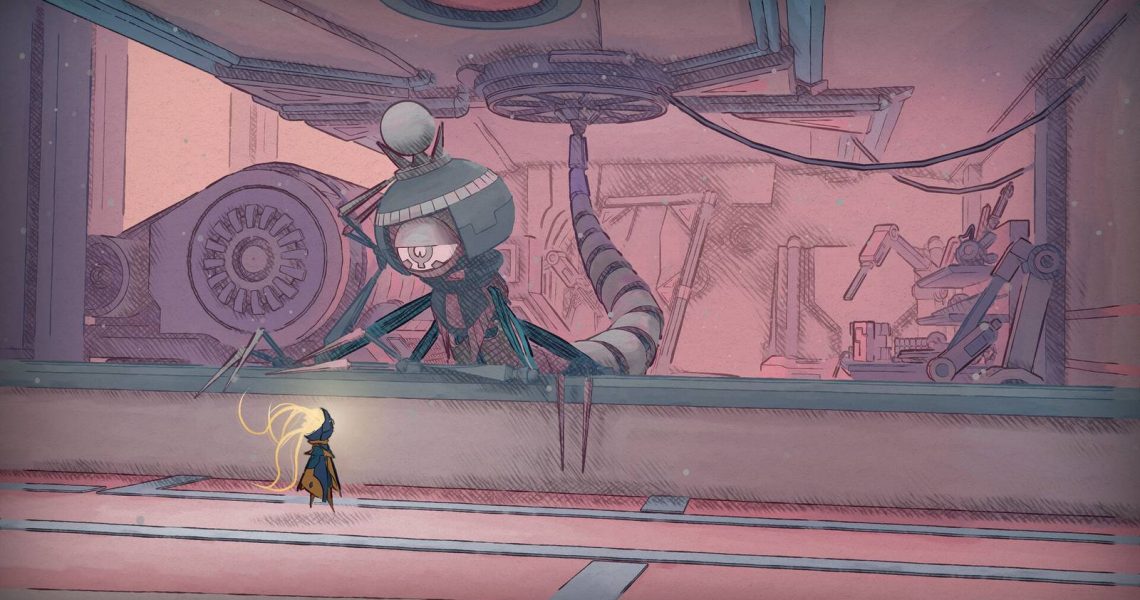
Hollow Knight is an easy comparison to draw upon when discussing MIO: Memories in Orbit, but the upcoming game could also be compared to something like Ori and the Blind Forest due to its emphasis on audiovisual ingenuity, semi-3D environments, and smooth platforming. Much like its studio’s last project, Shady Part of Me, MIO excels through hand-drawn, comic-book-style visuals and animations, which feel inspired by Moebius’ work while still feeling original. In short, the game’s aesthetic is complex and unique, blending a pastel color palette with smooth animation, heavy black lines, and inventive, unusual character designs. But MIO: Memories in Orbit wants to be more than just a pretty face, and it’s hoping to accomplish that through compelling storytelling, combat, and metroidvania principles.
What is MIO: Memories in Orbit About?
MIO: Memories in Orbit’s Story
Players assume the role of MIO, a robot who has woken up on a massive spaceship called the Vessel, without any of their memories. As it turns out, the Vessel suffered from a mysterious power blackout, causing many of its core systems to cease functioning. MIO must make their way through the bizarre and often inexplicable Vessel, powering up its machine denizens, and ultimately uncovering the truth behind everyone’s past.
To be perfectly frank, the plot itself doesn’t seem too groundbreaking at first glance. MIO: Memories in Orbit follows the ubiquitous amnesiac protagonist trope, which has long been something of a clutch for video game storytellers: it’s easy to implement unnatural expository dialog, or make the player relate to the player-character, by simply giving them amnesia. Amnesia can also elevate the tension or surprise of relatively mundane scenarios, as any and all revelations are significant to the protagonist.
This doesn’t mean that MIO won’t have a good story, of course. Developer Douze Diximes has described MIO’s past as “tragic,” suggesting that there will be actual weight and impact to story reveals, and the fact that the protagonist’s history is ostensibly mixed up with the game’s setting could make for some interesting worldbuilding. At the very least, MIO: Memories in Orbit could leverage the unique strengths of an all-robot, far-future cast for worthwhile commentary, philosophizing, and subversive lore beats. At any rate, MIO looks to have a lot more going for it beyond its story.
Of course, vague, abstract, and interpretable storytelling is often par for the course with metroidvanias, so MIO‘s cliché amnesiac premise might not be much of an issue.
MIO: Memories in Orbit Boasts Slick, Smooth Traversal
Early impressions of MIO: Memories in Orbit all focus on one corner of the gameplay sandbox without fail: traversal. The game features low-gravity environments with various layered obstacles, making for a locomotion sandbox that’s at once forgiving and disorienting. Douze Diximes aims to facilitate a sort of flow state through its movement mechanics, pushing the player to interweave abilities like gliding, wall-running, and grapple-hooking to move from point A to B swiftly and efficiently.
The game’s movement sandbox certainly looks appealing, and previews have been mostly favorable, but there’s been some conflicting chatter as well. Pain points raised in previews include MIO’s awkwardly slow movement speed, as well as miscellaneous oddities with the grapple hook, such as inconsistent grip-point recognition. Still, traversal in MIO looks smooth and stylish, and could very well be one of its greatest strengths.
MIO: Memories in Orbit’s Touchstones Will Hopefully Be Counter-Balanced by Originality and Innovation
Douze Diximes has explicitly named Hollow Knight, Celeste, and Dead Cells as comparisons to MIO: Memories in Orbit, and it’s not hard to see why. Aside from the fact that these games are almost universally lauded for their combat, traversal, or both, they are also all notoriously hard—something that MIO‘s marketing certainly hasn’t been afraid to boast about thus far. Indeed, MIO: Memories in Orbit seems to be leaning heavily into its quasi-soulslike influences, with Douze Diximes repeatedly describing it as satisfyingly challenging. According to the developer, MIO players can expect death to be a regular part of the experience.
But MIO promises to include other unique quirks that could set it apart from its competition. For example, it will feature a series of Modifiers, which have been compared to Nier: Automata‘s Plug-In Chips by multiple previewers: players will be able to sacrifice basic features like enemy health data for extra ability bandwidth through this system. Douze Diximes promises that this Modifiers feature, alongside mechanically interesting bosses, tailor-made action set pieces, and an ever-inspiring art style, will make MIO: Memories in Orbit a game worth sinking your teeth into, even for those who have already eaten their fill of metroidvanias over the years.

- Released
-
January 20, 2026
- ESRB
-
Everyone 10+ / Fantasy Violence, Mild Language
- Developer(s)
-
Douze Dixièmes
- Publisher(s)
-
Focus Entertainment
- Number of Players
-
Single-player