Open-World Games With the Best Exploration, Ranked
Exploration defines an open-world game’s value. The genre/concept/theme is synonymous with player freedom, and that usually comes in the form of massive sandboxes that let you go anywhere and, at times, do anything. You can travel as far as your skill can take you, and games encourage players to step away from the beaten path and see what the unknown holds in store for them.
The best open-world games often go well beyond the traditional waypoints and checklist system, instead delivering maps that provide some guidance but still satisfy a desire to wander, discover, and venture. The sheer volume of open-world games means dozens upon dozens of unique regions are just waiting to be explored, and they make the journey satisfying.

Free Open-World Games With The Best Exploration
These free open-world games offer vast and beautiful open worlds, great exploration, loads of content; there’s almost no catch.
9
The Witcher 3: Wild Hunt
The Best Open-World Game, Naturally, Has Great Exploration
Even more than a decade later, The Witcher 3: Wild Hunt is still the standard-bearer for open-world games, at least to a lot of people. Known for top-notch writing that extends to its quests, characters, and world-building, CD Projekt Red’s masterpiece famously set itself apart by paying exploration off with depth rather than just content. Side missions fleshed out the setting while delivering great self-contained stories that accentuate Geralt’s personality and the world at large.
Each continent’s map is littered with question marks that just demand to be unveiled, and they are generally rewarding enough to make you want to keep exploring. Admittedly, after a while, it can get exhausting to check all of these points off, but you are not punished for not completing them either. You can just explore leisurely while mainly focusing on the main quest, and you will still have a great time.
8
Ghost Of Tsushima
The Wind Carries More Than Just Leaves
Instead of filling the screen with waypoints and arrows, Ghost of Tsushima asks players to follow the wind — literally. It’s one of the most elegant UI decisions in open-world design, using a gust of wind to guide exploration. That subtle touch sets the tone for the rest of Tsushima Island. Jin Sakai’s journey from noble samurai to ghostly assassin plays out across golden fields, snow-dusted peaks and war-torn villages, but what makes exploration memorable is how every corner of the island tells a story. A chance encounter on a remote trail might start a tale of revenge or redemption.
The map is dense with meaningful landmarks, and the world reacts to Jin’s growing legend. Mongol patrols become more aggressive, villagers recognize his armor, and the island transforms with his actions. And then there’s Kurosawa Mode, which turns the whole game into a cinematic love letter to classic samurai films. It’s ideal for those who want their exploration with a side of dramatic flair.
Ghost of Yotei delivers an almost identical exploration experience to its predecessor.
7
Subnautica
Every Depth Could Mean Doom or Salvation
Subnautica throws players into an alien ocean with little more than a diving suit and the vague hope of survival. That’s exactly what makes its world irresistible. Planet 4546B is a masterclass in environmental storytelling, with its biomes arranged in a way that tempts players deeper into more dangerous territory the longer they survive. Instead of towering mountains or sweeping plains, the world wraps around players with coral reefs, volcanic trenches, and bioluminescent caves.

7 Open-World Games That Mastered The Art Of Slow Exploration
There have been some truly breathtaking open-world games over the years, and these titles let you explore at your own pace.
What elevates it beyond survival fare is the way the game hides its breadcrumbs. A wrecked escape pod or alien artifact might seem like random set dressing, but they lead to a bigger story. The lack of a traditional map makes every discovery feel earned, and the upgrades to vehicles and suits create a constant loop of wanting to see what lies a little deeper.
6
Outer Wilds
Dying Is Half the Discovery
Outer Wilds might not look like a traditional open-world game, but its solar system is one of the most intricate open environments ever created. Each planet is a puzzle, unraveling not with keys or gear upgrades, but with pure knowledge. The minute a new fact is uncovered, it changes the way players approach the world.
Exploration here isn’t about finding loot or checking off side quests. It’s about chasing a mystery through collapsing caves, quantum moons, and orbital anomalies, all governed by hard science rules. What’s even more impressive is that Outer Wilds trusts players completely. There’s no mission log or objective tracker, just a ship’s log that updates based on observations. It’s a rare kind of open world where the map doesn’t expand with icons, but with understanding. When the final pieces click into place, that sense of cosmic awe is something most games can’t touch.
5
No Man’s Sky
A Universe That Was Broken and Then Reborn
At launch, No Man’s Sky was infamous for missing features, empty planets, and a galaxy that felt emotionally vacant. But in a twist no one saw coming, Hello Games spent years rebuilding it into one of the most impressive exploration experiences in gaming. Now players can explore planets with unique weather systems, alien biomes, and buried tech. The procedural generation works now, producing lifeforms and landscapes that are weird in the best way, from floating jellyfish fields to sentient storm-forests.
What makes exploration work here is scale and freedom. Nothing’s stopping players from exploring every cave system on a volcanic planet, or warping across galaxies to chase a rare mineral. With vehicles, freighters, and base-building, there’s always a new way to engage with the universe. The added storylines bring purpose to exploration. But even without them, taking off from a planet and landing on another is one of gaming’s most satisfying acts.
4
Red Dead Redemption 2
A Landscape That Remembers Every Footstep
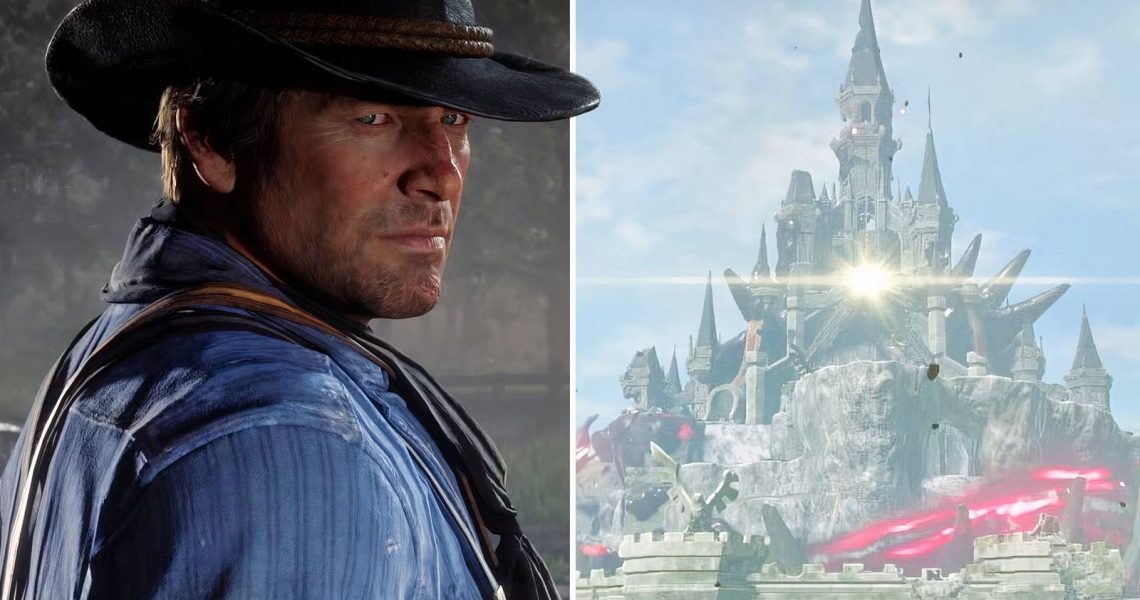
The American frontier in Red Dead Redemption 2 is not only massive, but it’s also hauntingly alive. Mountains shift color with the time of day, snow gathers on Arthur’s coat, and animals react naturally to the player’s presence. But it’s not just visual fidelity that makes exploration shine here — it’s context. Every inch of the world ties into the story of the Van der Linde gang and their doomed attempt to outrun change.

8 Best Open-World Games Where Exploring Freely Is More Rewarding Than The Main Story
These open-world games do offer a main story campaign to complete, but their settings are so immersive that exploration almost always takes priority.
There’s no pressure to fast-travel or rush. This is a world meant to be lingered in, whether that’s fishing in the bayou, following a strange sound into the woods, or riding through a thunderstorm and watching lightning strike a tree in the distance. And then there’s Guarma, a completely different island with its own ecosystem and politics. It’s the kind of unexpected detour that proves Rockstar isn’t afraid to toss the map and go somewhere wild.
The Northern Wilds Are Calling, and They Have Dragons
Once Skyrim’s Helgen escape ends, players are unleashed on a world that doesn’t just encourage wandering — it assumes it. Part of what makes Skyrim’s exploration timeless is how modular everything feels. A dungeon halfway up a mountain might have its own mini-storyline, complete with ghosts, traps, and a unique weapon. A random bandit hideout could lead to a side quest that spirals into a political conspiracy. And thanks to radiant quests and emergent AI behavior, no two journeys look the same.
The geography of Skyrim is also deceptively clever. The region is divided into distinct holds with their own cultures, politics, and terrain, all arranged in a way that naturally leads players from snowfields to volcanic rifts to autumnal forests. And that’s before mentioning the modding scene. For many, exploration in Skyrim doesn’t stop at the edge of the map — it extends into player-made worlds.
2
Elden Ring
A Kingdom of Secrets, Buried in Ruins
Elden Ring took FromSoftware’s punishing design and married it to a sprawling open world, creating one of the most compelling exploration loops in modern gaming. Limgrave is already dense with ruins, catacombs, and mini-bosses, but that’s just the tip of the Erdtree. Beneath the surface lies Nokron, a sunless city filled with spectral warriors. Further north, Caelid’s festering wasteland offers a grotesque contrast to the golden plains players start in. A random cave teleports players halfway across the map to a crystal cave filled with rot and cosmic horrors.
What makes Elden Ring’s exploration so addictive is how little it explains. There’s no quest log or icon clutter. Every detour feels like it might lead to something extraordinary, fatal, or both. The game also rewards persistence. A door sealed by a statue could require a key found in a forgotten ruin two regions away. But the payoff is always worth it, whether it’s a legendary weapon or a cutscene that reframes the story’s timeline.
1
The Legend Of Zelda: Breath Of The Wild
Yes, Link Can Climb That
No paraglider? Just climb. That’s the energy Breath of the Wild brings to open-world design. It strips away conventions like level-gated zones or invisible walls, and replaces them with mechanics that encourage genuine experimentation. Exploration in Hyrule is about not only reaching a location, but figuring out how to get there. Players can scale that distant mountain with enough stamina or clever food buffs. A puzzle shrine hidden in plain sight might need Link to roll a boulder down a hill from half a mile away.
What makes it stick is the consistency. Fire burns grass. Metal conducts electricity. Cold weather saps stamina unless Link’s bundled up. Exploration becomes a series of improvised solutions, and the world’s verticality rewards creative traversal. Even the story is fragmented in a way that serves exploration. Players can uncover memory cutscenes in any order or stumble across a dragon gliding through the sky during a thunderstorm. Years later, players are still discovering new mechanics, tricks, and secrets. While Tears of the Kingdom expanded on the formula, it was Breath of the Wild that cracked open what an open world could be.
Honorable Mentions
Simply put, there are way too many open-world games with fantastic exploration. Heck, an argument could be made that all good entries in the genre excel in this area, as exploration really is the cornerstone of sandboxes. As we cannot cover everything, here are a few games that could easily slot in somewhere during this discussion.
- Ark: Survival Evolved
- Assassin’s Creed Odyssey
- Atomfall
- Days Gone
- Dragon’s Dogma: Dark Arisen
- Gothic 2
- Horizon Forbidden West
- Kingdom Come: Deliverance 2
- Once Human
- Outward
- Sable
- S.T.A.L.K.E.R. 2: Heart of Chornobyl
- Where Winds Meet

10 Best Open-World Games If You Want An Escape From Reality, Ranked
Struggling to deal with the real world? These open-world games have you covered, offering expansive worlds and lengthy play times as a distraction.