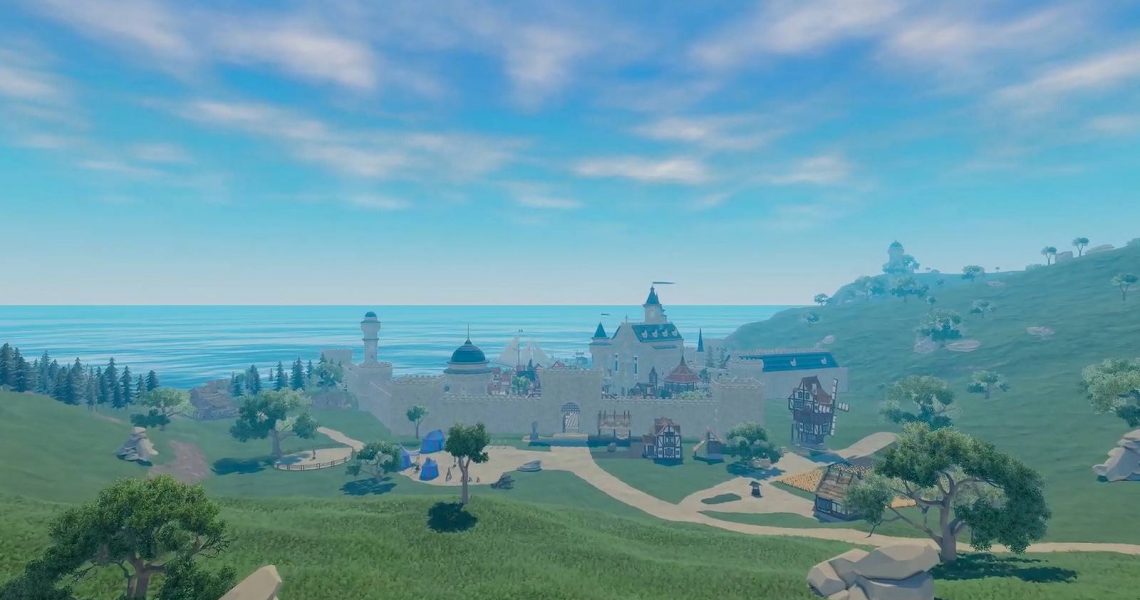
Breath of the Wild, and That’s a Real Shame
Almost a decade ago, The Legend of Zelda: Breath of the Wild set a new standard for the open-world genre. Before its release, the novelty of vast open worlds had already worn off, as gamers began to realize that it took more than square miles to make a worthwhile open-world game. When Breath of the Wild entered the picture, however, it proved that open worlds could thrive on curiosity and the thrill of discovery rather than simply being host to a massive checklist of activities. Since then, many games have attempted to capture the same magic and even improve on the formula, while others—like Finale Games’ open-world RPG Myths of Gallantium—are not ashamed to openly cite Breath of the Wild as one of their inspirations. Unfortunately, despite Myths of Gallantium still having a Steam page, the likelihood of it ever becoming a playable reality is slim, and that’s a real shame.
Myths of Gallantium first launched its official Steam page on June 6, 2022 and has largely flown under the radar since then. It still has its own subreddit with a handful of followers where it once shared updates on its development, and the early footage even looked promising. According to the game’s description, it was “inspired by the atmosphere of Zelda: Breath of the Wild,” and it looks and plays like Runescape. However, despite having such a solid premise and seeming to be a fully-fledged concept already taking shape several years ago, development on Myths of Gallantium was apparently halted around that time, with Finale Games claiming “life” got in the way. That doesn’t mean it will never see the light of day, but things certainly don’t look good for it.
Myths of Gallantium’s Features at a Glance
- OPEN-WORLD EXPLORATION – Vast world with three major continents, varied civilizations, and interconnected seas to explore.
- ACTION RPG COMBAT – Real-time battles against monsters, bosses, and enemy camps throughout the world.
- FLEXIBLE CLASS SYSTEM – Seven distinct skill-trees (Knight, Hunter, Mage, Angel, Paladin, Rogue, Summoner) that can be mixed and matched.
- CHARACTER CUSTOMIZATION – Customize both appearance and build; respec at any time.
- MULTIPLE CHARACTERS PER WORLD – Create up to three characters sharing the same world, each with its own progress and role.
- SANDBOX ACTIVITIES – Build houses and farms, grow relationships, pursue quests, craft and trade goods.
- SAILING AND SEA EXPLORATION – Craft and sail ships, hunt treasure, trade between continents, fight or become pirates.
- QUESTING AND PUZZLES – Engage in NPC quests, solve world puzzles, and conquer arenas.
- LOOT AND EQUIPMENT – Find, craft, buy, and equip gear to build your hero how you want.

Myths of Gallantium Adopts the Atmosphere of Zelda: Breath of the Wild
Sail the seas, hunt treasures, trade goods, or become a pirate. Why not do it all?
One of the most iconic features of Zelda: Breath of the Wild‘s open world is, without a doubt, its unbounded design. It’s not the only open-ended game out there, but it is one of the few that doesn’t funnel players along a set path and puts them wholly in charge of their destination. Open-world games are known for the freedom they offer, but Breath of the Wild‘s lack of objective markers and map icons truly unshackles players, giving them a sense of self-directed discovery in its vast world. According to what Myths of Gallantium claims and appears to be, it seems to offer that same level of freedom, allowing players to approach the game in any way they see fit.
Nothing in Myths of Gallantium‘s Steam description explicitly says, “X is how it’s like Zelda: Breath of the Wild,” but several characteristics point to the same design philosophy the beloved Zelda game observes. Firstly, in Myths of Gallantium, “there is something to do for any kind of player. Fight monsters, dungeons, bosses, build houses, craft items, trade, solve puzzles and help villagers with quests.” This channels the spirit of Breath of the Wild by emphasizing player freedom and open-ended exploration over rigid progression, encouraging players to discover and interact with the world on their own terms rather than being led down a single prescribed path. In Breath of the Wild, this emphasis on choice and self-directed play helps make the world itself the core of the experience, where exploration and emergent opportunities feel rewarding because they serve the world itself and not just a checklist of objectives.
Secondly, in Myths of Gallantium, “the world of Gallantia spans over multiple continents. Craft your sailing ship and sail ahead to explore the world. Fight pirates, or become one, trade rare goods between two continents, or hunt for treasures. The waters are yours.” This mirrors the exploratory mindset of Zelda: Breath of the Wild by making traversal itself a form of discovery rather than merely a means to an end. Just as Breath of the Wild encourages players to climb a mountain simply to see what lies beyond it, Myths of Gallantium‘s open seas and sizable world suggest an experience where curiosity drives movement, and where the journey itself is just as worthwhile as the destination.
Myths of Gallantium Looks and Plays Like Runescape
Perhaps the biggest differences between Myths of Gallantium and Zelda: Breath of the Wild, though, are its visuals and gameplay. Unlike Breath of the Wild, Myths of Gallantium is an RPG with far more flexibility in its gameplay. Sure, players can change up combat by using Breath of the Wild‘s diverse arsenal of weapons, and its sequel, Tears of the Kingdom, takes that even further with the Fuse ability. However, in Myths of Gallantium, players have access to 7 distinct skill trees (Knight, Hunter, Mage, Angel, Paladin, Rouge, and Summoner), and they aren’t limited to playing just one. Rather, the open-world RPG allows players to mix and match up to two skill trees at the same time, resulting in a wider variety of possible playstyles than what Breath of the Wild provides.
This is actually closer to how Runescape plays, though it doesn’t restrict characters to classes at all. Instead, Runescape allows players to be anything they want to be by giving them access to all skills and allowing their playstyle to be entirely defined by choice. Myths of Gallantium, then, ends up being a happy medium between Breath of the Wild‘s open-endedness and Runescape‘s flexibility. Plus, it feels even more like Runescape in its visuals, which lean more into the cartoonish side of things than Breath of the Wild does.
For Now, Myths of Gallantium Remains a Dream
Despite its promise, Myths of Gallantium is little more than a dream at the moment. While development was ongoing several years ago, the developer confirmed just under a year ago that “life” got in the open-world RPG’s way, and there has been no sign of it being revived. After another developer made a post in the game’s subreddit stating that Myths of Gallantium inspired them to make a game, Final Games commented, saying, “hope it reaches the heights Myths of Gallantium never did!” Another Reddit user then replied to the developer’s comment, asking why development stopped on Myths of Gallantium, to which Finale replied, “Life.”

It’s unclear whether the game will ever come to fruition, but it seems like things are leaning more toward it never happening. Myths of Gallantium‘s Steam page is still up, though, so perhaps Finale Games is simply waiting for life to slow down a bit so it can return to the grind. That being said, Grant Oganyan, head of Finale Games, stated on his X page in 2022 that he was “taking a break from gamedev,” and no updates have been made since then regarding the game. Still, here’s hoping that Myths of Gallantium eventually surfaces in a big way. There’s always room for more Breath of the Wild-likes in the world.