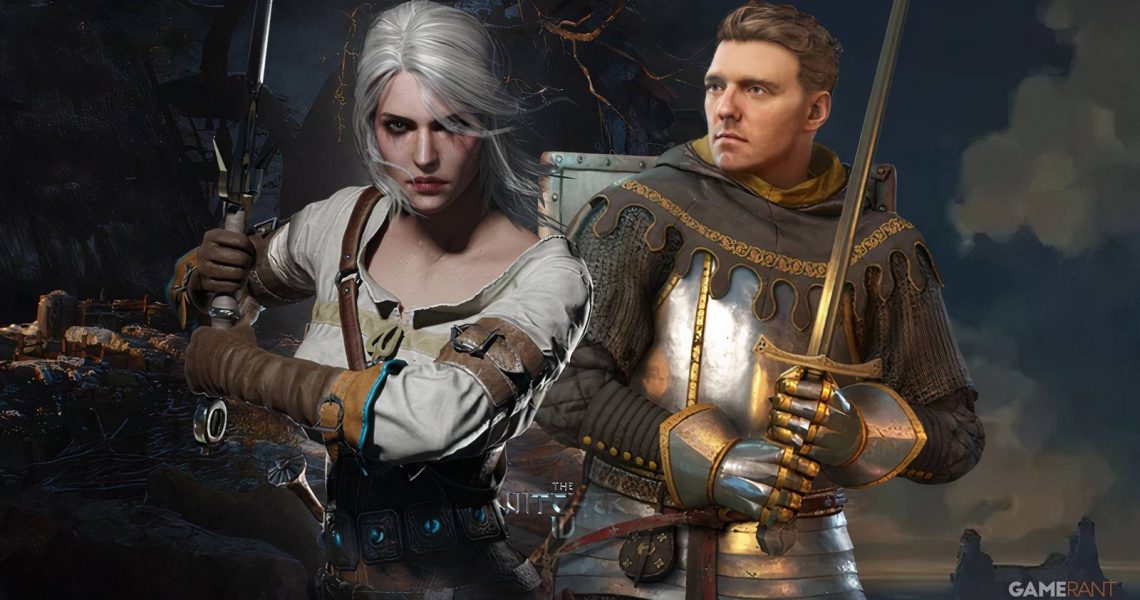
What to Expect From The Witcher 4 After Kingdom Come Deliverance 2’s Influence
When devs at CD Projekt Red confirmed that Kingdom Come: Deliverance 2 is serving as a key source of inspiration for The Witcher 4 in 2025, it immediately reframed expectations for the RPG’s potential. The Witcher series has always balanced dark fantasy with grounded worldbuilding, but Kingdom Come represents an even more uncompromising approach to realism, simulation, and player-driven immersion.
The Witcher and Kingdom Come: Deliverance are as different as franchises can be. One is set in a world of gritty historical realism while the other is defined by its most fantastical lore. However, CD Projeckt Red citing Warhorse Studios’ GOTY-nominated title as a source of inspiration should be music to a player’s ears. Looking closely at Kingdom Come: Deliverance 2 and how its design philosophy can contrast with and complement The Witcher 4 offers a clearer picture of Ciri’s next adventure.

Kingdom Come: Deliverance 2 Testers Thought Its Stealth System Was Bugged Because It Felt Too Real
Game Rant sat down with Kingdom Come: Deliverance 2 design director Viktor Bocan, who explained why testers mistook its realistic stealth for a bug.
The Witcher 4 Will Shift Toward a More Reactive, Lived-In World
One of Kingdom Come: Deliverance 2’s defining traits is its reactivity. The world responds not just to narrative choices, but to moment-to-moment player behavior, often in subtle and systemic ways. That influence is already visible in The Witcher 4’s technical demo, which emphasizes an environmental response to Ciri’s presence and actions. This could manifest through:
- NPCs reacting dynamically to Ciri’s reputation, equipment, or recent actions.
- Environmental changes tied to player movement, magic use, or combat encounters.
- Less reliance on scripted set pieces and more emergent world behavior.
Where The Witcher 3 often compartmentalized reactivity into quest outcomes, Kingdom Come: Deliverance 2 treats reactivity as a baseline expectation. If that philosophy carries over, The Witcher 4’s open world may feel less like a stage and more like a living system that continuously acknowledges the player.
Deeper, More Hands-On Gameplay Systems
Part of KCD2’s realism was defined by how hands-on its systems were. Nearly every mechanic in KCD2 asks the player to engage physically and mentally, rather than abstractly through menus. In The Witcher 3:
- Potions are crafted instantly via inventory menus.
- Weapon maintenance is reduced to a single interaction.
- Preparation systems are largely automated.
By contrast, Kingdom Come: Deliverance 2 treats these mechanics as gameplay in their own right. Examples that The Witcher 4 could reasonably adopt include:
- Manual crafting systems like in KCD2 where potion-making involves ingredient sequencing, timing, and physical interaction.
- Expanded weapon maintenance, potentially turning sharpening and repair into skill-based activities rather than passive buffs.
- Alchemy as a risk-reward system, where mistakes have consequences rather than simply wasting materials.
This approach favors immersion over convenience. It is slower, more animation-driven, and intentionally tactile. This would be an adjustment that could significantly alter the moment-to-moment pacing in The Witcher 4.

The Witcher 3’s Rumored DLC Would Be Good News for Players but Bad News for Geralt
The rumored 2026 Witcher 3 DLC may bridge the gap to The Witcher 4, but that doesn’t necessarily bode well for Geralt’s fate.
The Witcher 4’s Combat Might Be More Complex If It Took Notes from Kingdom Come: Deliverance 2
Who’s That Character?

Identify the silhouettes before time runs out.
Identify the silhouettes before time runs out.
Easy (7.5s)Medium (5.0s)Hard (2.5s)Permadeath (2.5s)
Kingdom Come: Deliverance 2’s combat diverges sharply from traditional action RPG design. It is far from beginner-friendly, but its complexity welcomes seasoned RPG players with open arms. Its influence could significantly reshape The Witcher 4. Rather than fast, animation-cancel-heavy encounters, Kingdom Come emphasizes directional attacks and defensive positioning alongside stamina management that actively discourages button mashing. Applied to The Witcher 4, this could mean a noticeable shift away from the fluid, almost power-fantasy combat loops of The Witcher 3. Potential changes include:
- Swordplay with a greater emphasis on precise timing.
- Fewer invincibility frames and more punishment for overextension.
- Enemy encounters designed around dueling and attrition instead of strict crowd-clearing.
With Ciri as The Witcher 4’s protagonist, this approach would not necessarily slow combat down, but it could make every strike and dodge feel more deliberate and consequential.
Preparation as Gameplay, Not a Checklist

One of Kingdom Come’s most influential design philosophies is that preparation matters and that it should take time. This would add to the experience’s overall difficulty, but with intention instead of inconvenience. Translating this to The Witcher 4 could mean:
- More meaningful pre-combat rituals, including more involved potion preparation and equipment checks.
- Less reliance on universal solutions and more situational problem-solving, expanding on systems present in The Witcher 3.
- Systems that reward foresight rather than improvisation.
This aligns naturally with The Witcher universe, where monster hunting has always been about research, preparation, and knowledge. The difference lies in execution: The Witcher 4 may ask players to actively perform that preparation instead of merely selecting it from a menu.
A Deliberate Evolution Inspired by Kingdom Come, Not a Reinvention of The Witcher
The Witcher 4 is unlikely to become a full simulation RPG in the mold of Kingdom Come: Deliverance 2. CD Projekt Red has consistently prioritized accessibility and narrative momentum, and with masterclass side-quest design, its identity will be fully its own. However, a selective adoption of KCD2’s systems could signal a more mature, more demanding evolution of the franchise. If executed carefully, The Witcher 4 could represent a synthesis of both approaches: the narrative depth and character-driven storytelling the series is known for, paired with systems that ask players to slow down, engage deeply, and earn their victories. For longtime fans, that shift may feel less like a departure and more like The Witcher finally leaning all the way into what it has always promised.