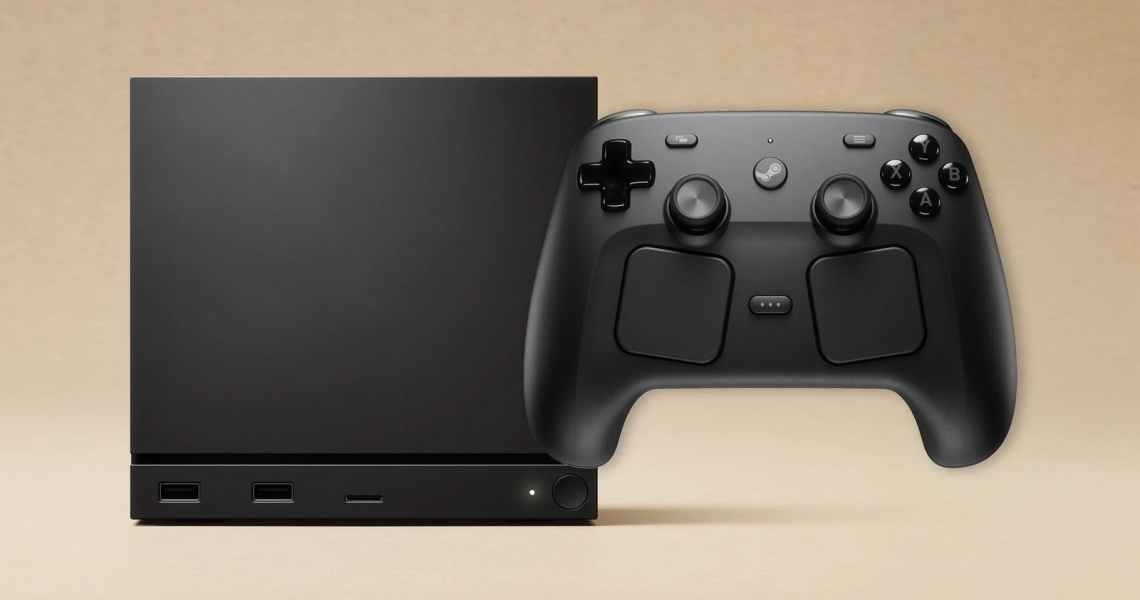
Steam Machine Hardware Has Me Worried About the PS5’s Long-Term Future
The Steam Machine is set to release in early 2026, and it has a chance to shake up the industry in a major way. Granted, Valve’s first attempt at a home console was a bit of a blunder, but after the company’s Earth-shattering success with the Steam Deck, something like the Steam Machine doesn’t seem like such a crazy idea.
In fact, Valve reports that the Steam Machine is “six times as powerful” as the Steam Deck, and while this is mostly marketing speak (“power” is a vague and complex concept in gaming tech, and isn’t a linear spectrum), it’s not unfounded. Compared to the Steam Deck, the Steam Machine has considerably more compute, a newer-generation CPU, and more DDR5 RAM availability, while still using the same general architecture as the Deck. To put things in perspective, all Steam Deck models have eight compute units (a way of measuring processing power), while the Steam Machine has twenty-eight, putting it in bold conversation with Sony and Microsoft’s next-generation consoles.
The PlayStation 5 Is King, but Perhaps Not for Long
The so-called “big three” of gaming console manufacturers have been Nintendo, Sony, and Microsoft, at least for the past three decades or so. But while the three were in fairly direct competition in the early-to mid-2000s, focusing on a wide variety of games, experimenting with different ideas and strategies, and making use of ever more powerful hardware, things began to change with the launch of the PS3, Xbox 360, and Wii. Nintendo became much more experimental with its hardware—an approach that would eventually pay off with the Nintendo Switch— while Xbox and PlayStation competed through, among other things, console exclusives.
Xbox slowly deprioritized exclusive games, and has now seemingly abandoned the practice altogether, leaving the PS5 as the de facto home console: it has the most AAA games, and the fewest compromises. So, PlayStation has won its war with Xbox, but it was a war fought with soon-to-be-obsolete weapons and strategies. The Steam Machine is going nuclear.
Sony Can’t Possibly Be Ready for the Steam Machine If It Meets Expectations
PC gaming has several advantages over console gaming, but these are often overlooked by general audiences. It could be because PC gaming seems culturally distant from console gaming, or more impenetrable due to its DIY nature—gaming consoles require little to no setup or calibration, whereas even pre-built PCs need to be fiddled with to some degree. PC gaming culture also lacks the brand loyalty and heritage of console gaming. But each of these factors, while perhaps drawbacks normally, may either disintegrate or be flipped into a positive via the Steam Machine.
Console and PC gaming are differentiated in many ways, but none is more significant than the issue of decentralization. In the case of PlayStation, much of the user experience is dictated solely by the whims of Sony itself. Consumers have no real recourse if they find the PlayStation Store unsatisfactory, for instance, whereas a PC user could simply switch to a different launcher or digital storefront. Steam itself was forged in these conditions, which is why it’s one of just a few examples of the free market working as intended: Steam is the most popular games launcher as a direct result of its consumer-friendliness.
Backwards compatibility is another area where any Windows- or Linux-based gaming platform easily outperforms consoles, especially PlayStation. To this day, support for pre-PS4 games on PS5 is lackluster and inconsistent, with many games only accessible through PlayStation’s premium streaming service. But as long as a game has had a PC release, it will probably be playable on the Steam Machine: any Linux-compatible launchers and games can be booted on Valve’s upcoming “console.” Beyond that, the Steam Deck is excellent for PS1, PS2, PS3, and even Xbox 360 emulation, further broadening users’ horizons in a way that a traditional console like the PS5 simply cannot. It should be assumed that the Steam Machine will be the same way.
All told, Steam has the largest and most diverse gaming library, not just because of classic games, but also because of indies that haven’t been ported to consoles yet, and because Xbox and PlayStation have both spent the past few years migrating their exclusives to PC. Indeed, with some notable exceptions, there are almost no games that you can play on PS5 or Xbox Series X that aren’t also available on PC.
This is to say nothing of the Steam Machine’s other strengths, like completely free online multiplayer and the absence of frustrating practices like $10-20 “next-gen upgrades,” but these are strengths of PC gaming more broadly. The Steam Machine’s real test will be whether it can match a traditional console’s ease of use and overall convenience. SteamOS has proven to be a terrific, console-like experience on the Steam Deck, so there’s no reason to believe that that won’t be the case with the Steam Machine. This won’t be the only hurdle for the Machine to clear, though.
Pricing Will Make or Break the Steam Machine
The biggest question mark surrounding the Steam Machine right now is its price, which Valve remains tight-lipped about. This is so important for a few reasons, not the least of which being the rising cost of gaming hardware and video games themselves, and the fact that, technically speaking, the PS5 and Xbox Series X are quite cheap for what they offer hardware-wise: building a PC with PS5-adjacent power would cost much more than simply buying a PS5. We know that Sony sells its consoles at a loss in exchange for bringing more users into its ecosystem, so perhaps the Steam Machine will do the same. After all, Valve does take 20-30% of each Steam sale, for games that generate a certain amount of revenue.
The Steam Machine’s real test will be whether it can match a traditional console’s ease of use and overall convenience.
Because if Valve does intend to profit from each Steam Machine unit sold, the device could wind up being quite expensive indeed; some analysts and leakers have even suggested that it could retail for as much as $1000. In theory, one could probably justify the Steam Machine’s higher cost by pointing out things like free online multiplayer, but a too-high cost of admission would probably nudge people closer to a PlayStation or Xbox regardless of any cost-benefit analysis. The Steam Machine could maybe get away with being a bit more expensive than a PS5 Disc Edition, but not by much. Ultimately, though, the Steam Machine seems poised to overthrow the PS5 in nearly every way, which is concerning for any owners of Sony’s current console.