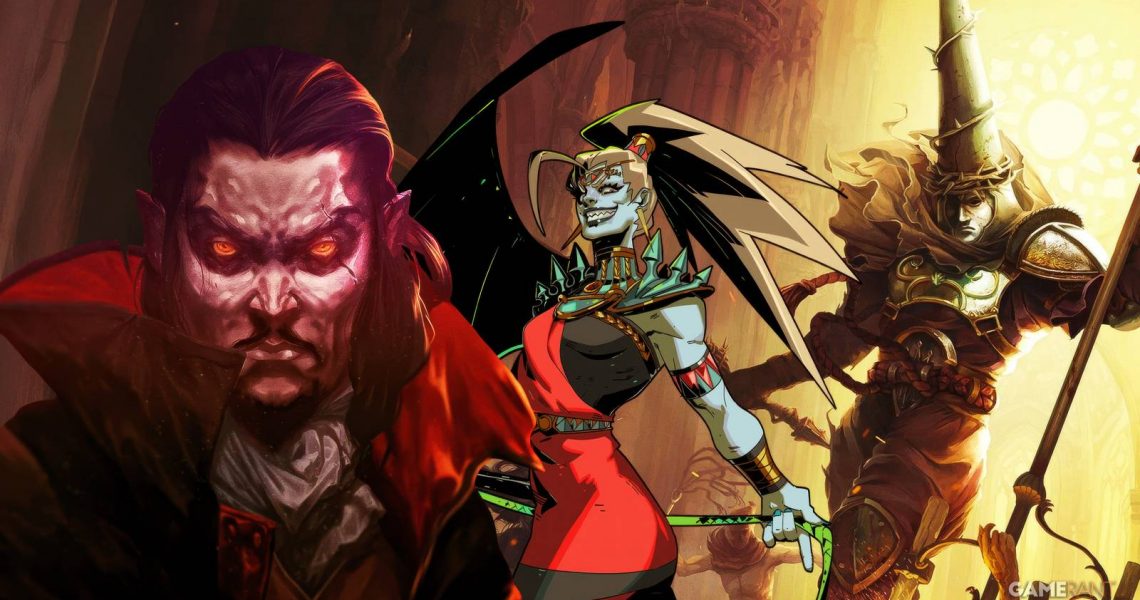
New Dark Fantasy RPG is a Mix of Hades, Vampire Survivors, & Blasphemous
So-called “survivor-like” action-RPGs are having a heyday, and Ember and Blade seeks to add to this ever-growing pool of addictive excellence. Indeed, the upcoming indie game, whose developers explicitly name Vampire Survivors as an inspiration, mashes the dark religious themes of Blasphemous with Survivors auto-gameplay elements, while adding a dash of Hades‘ expressive storytelling and roguelike stylings for good measure.
The first thing you might notice about Ember and Blade is its striking art direction. It adopts a fixed isometric perspective like the Hades games, but with a 3D art style splattered with vibrant lighting, and neon-like VFX that are reminiscent of Furi, of all games. This bright and dynamic visual design makes the overwhelming hordes of enemies much more palatable than those of many other survivor-like games, whose busy enemy encounters can sometimes devolve into muddy, ugly moving murals. This art style is contrasted by stunning, hand-drawn character portraits, which is where Ember and Blade is perhaps at its most Hades, aesthetically. These elements should make the Steam game a feast for the eyes, but it also has the mechanical heft to back up its pretty face.
Ember and Blade Channels Vampire Survivors’ Chaotic Combat
Cut through bullet-hell swarms, clash with Souls-like bosses, and harness celestial blessings that reshape your powers each run.
At a glance, Ember and Blade‘s gameplay is remarkably similar to that of Vampire Survivors, in the sense that success is based more on positioning and strategic upgrading than actual attack inputs. The player-character, Fenrix Haven, begins each run with a ranged weapon that fires automatically, and the majority of in-run upgrades grant additional automatic attacks, all on different cooldown timers. Fenrix’s health is relatively low, so careful and intentional movement is paramount for success.
But Fenrix also starts each run with a melee weapon that requires manual inputs: melee weapons have a basic combo as well as a special, more powerful move that charges up over time. This adds another layer to the classic Survivors combat sandbox, especially when certain upgrades help the manual weapons synergize with auto attacks. For instance, you can find an item that reduces the cooldown for all auto attacks with every manual attack.
There are also some other clever subversions of the traditional Survivors gameplay loop. For instance, Fenrix has a modular shield that recharges over time, allowing players to tank one or two hits before their health starts to deplete. This makes Ember and Blade more forgiving as well as more strategic than many of its contemporaries, as risk-taking is incentivized even at low health. Fenrix also has a manual dodge roll, which makes avoiding enemy attacks more dynamic and less chance-based.
How Ember and Blade Shakes Up the Classic Hades Gameplay Loop
Just like Ember and Blade mixes up the gameplay format popularized by Vampire Survivors, so too does it recontextualize many of the design pillars of Hades. Fenrix will be granted “boons” by various angelic spirits, though again, these are usually auto-attacks, such as a rain of meteor showers or a series of smaller projectiles fired upon a dodge roll. They can also be repeatedly and easily upgraded, allowing for an ostensibly higher power ceiling than other Hades-likes.
More interesting than Ember and Blades‘ spin on Hades-style progression elements is its unique structure. Runs take place in sprawling arenas, which become populated with more, increasingly powerful enemies as time goes on—it’s quite similar to Risk of Rain in this way. Instead of gaining boon-style upgrades upon clearing rooms or zones, you’ll increase your power upon defeating a certain number of enemies and collecting the XP tokens they drop. As such, aggressive grinding and risk-taking is rewarded. Fenrix can also grow considerably more powerful across runs thanks to a skill tree, lending the game a more conventional ARPG progression scheme.
Like Blasphemous, Ember and Blade Creates a New Mythology
At the heart of The Game Kitchen’s Blasphemous series is strong, original religious lore. The games certainly borrow from Abrahamic religions like Christianity, but they are far from literal adaptations. Similarly, Ember and Blade is loosely inspired by Greek and Norse mythology (with these elements being presented in the same unceremonious manner as Hades), but its pantheon is entirely original. There’s a lot of potential here, since the game doesn’t have to adhere to pre-established rules, events, character relationships, and the like.
Ember and Blade is lighthearted, but there’s an undercurrent of darkness that’s already clear at this early stage. It will be interesting to see how the story unfolds in the final product, since the narrative is a little bit cliché and derivative from the outset. I’ll also admit that Ember and Blade‘s quirky and juvenile dialog isn’t really my cup of tea, though it might click better with other players. Still, I found myself chuckling at a few jokes here and there throughout the demo, which says something—again, I’m prejudiced against its writing style.
One thing’s for sure: Ember and Blade‘s gameplay packs a serious punch. It’s chaotic, appropriately difficult, dynamic, and hides a good deal of depth within distinct, smart gameplay systems. The overall quality of its story remains to be seen, but so far, the game is shaping up to be a great addition to the action-roguelike space.
Ember and Blade is set to release in Q3 2026.