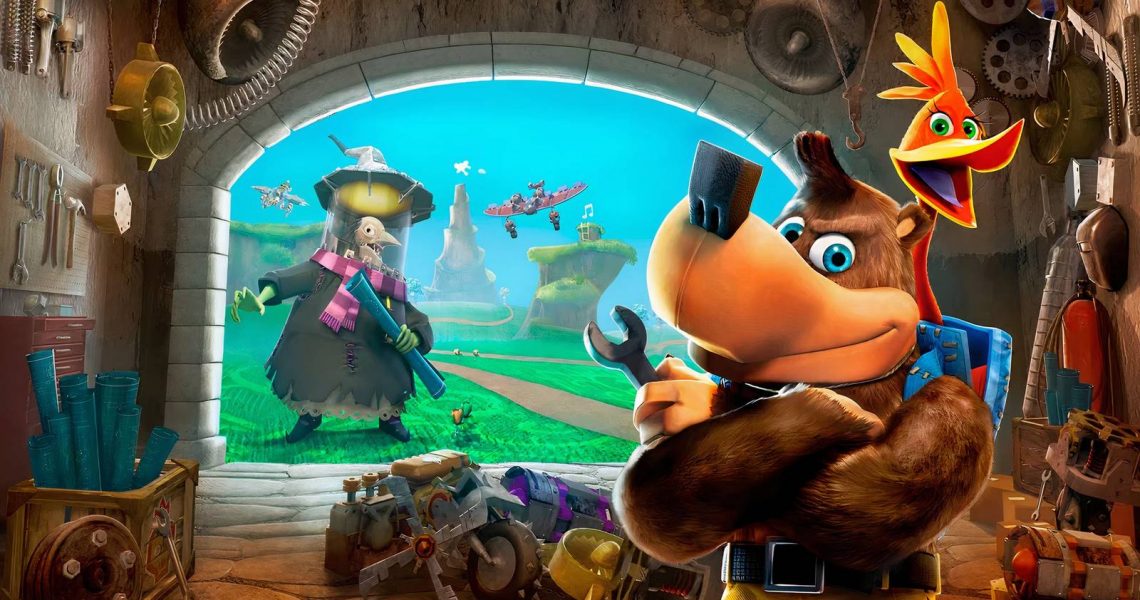
17 Years Ago, Xbox Released the Best Banjo-Kazooie Game (And It Killed The Franchise)
Reinvention has been known to kill franchises now and again in the gaming industry, and 17 years ago, Xbox released a Banjo Kazooie game that did exactly that. In 2008, Banjo-Kazooie: Nuts and Bolts arrived with very little warning about what it actually was. Players probably picked it up expecting another classic platforming adventure, only to discover a massive sandbox powered by vehicle building and physics puzzles. Almost overnight, the latest Banjo-Kazooie was swimming in a pool of disappointment, despite critics and players at the shallow end of that pool lobbing praises at it for its creativity. Unfortunately, those praises weren’t enough to keep it from drowning, and the franchise along with it.
17 years later, Banjo-Kazooie: Nuts and Bolts has become something of a case study for how a game can be both brilliant and controversial at the same time. It pushed the beloved Banjo-Kazooie formula into a brand-new direction, and yet it was a risk that stopped the series in its track for nearly two decades. Despite being the most inventive version of Banjo-Kazooie ever made, it may also be the reason the franchise never fully recovered.
Why Nuts and Bolts is the Best Banjo-Kazooie Game
While there is always space in any franchise for the statement “The first game will always be the best,” Banjo-Kazooie: Nuts and Bolts was arguably the series at its best. Nostalgia alone can only sustain interest in the first title of an IP for so long before it’s dethroned by reinvention, and Nuts and Bolts did that for Banjo-Kazooie. While it retained much of the series’ character in its humor and design, it introduced a world of sandbox creativity that only recent games like The Legend of Zelda: Tears of the Kingdom have been able to achieve. In fact, Banjo-Kazooie: Nuts and Bolts could easily be called the Tears of the Kingdom of its time.
Banjo-Kazooie: Nuts and Bolts replaced traditional 3D platforming with a vehicle-building system that allowed players to design cars, planes, and boats—practically anything they could think of—and then use them to travel across worlds, complete missions, or just get lost in the chaos. It was ahead of its time, to say the least, with its main problem perhaps being that it was a Banjo-Kazooie game. On its own, the “Nuts and Bolts” aspect of the game might have succeeded, but when it was used to transform a formula that many gamers had already grown attached to, it might have dug its own grave.

Nevertheless, in retrospect, Banjo-Kazooie: Nuts and Bolts feels like a precursor to modern sandbox games, including those with open-world exploration, deep customization, and player-led creativity. Some modern titles that are praised for these features even invite comparison to Nuts and Bolts—and the same arguments used to praise newer sandbox-platform hybrids apply here as well. There was freedom to experiment in Nuts and Bolts that led to the improvisational design philosophy now seen in games like Zelda: Tears of the Kingdom, and were social media as prevalent then as it is today, it might have received similar attention in YouTube shorts and TikTok compilations. All things considered, it’s difficult not to see the most controversial Banjo-Kazooie title ever made as playing a major role in where these other games have drawn inspiration.
Nuts and Bolts Was Called a Franchise Betrayal
- Fans wanted a traditional 3D platformer
- The Banjo-Kazooie name felt misleading
- Missions felt shallow, repetitive, and basic
- Vehicle handling lacked precision and polish
- It was missing the platforming progression fans loved

Almost everything about what Banjo-Kazooie: Nuts and Bolts was caused it to inherit the “franchise betrayal” label not long after its release. Longtime fans of the series expected a traditional 3D platformer, perhaps even one named “Banjo-Threeie” after its predecessor, Banjo-Tooie, seemed to establish a pattern. Instead, perhaps calling it a Banjo-Kazooie game in the first place was the wrong move, since many of its players seemed to see it as the furthest thing from a Banjo-Kazooie game, and yet it still carried the franchise’s name.
In retrospect, Banjo-Kazooie: Nuts and Bolts feels like a precursor to modern sandbox games
The root problems went much deeper than the name, though, as the new formula resulted in weak design across the board, even with some more innovative mechanics at play. Mission design was often called shallow and repetitive, with some missions being little more than monotonous fetch quests or races. Then, vehicle handling in Banjo-Kazooie: Nuts and Bolts wasn’t all that great either, and to top it all off, the game largely lacked the platforming progression of the original games.

After the release of Banjo-Kazooie: Nuts and Bolts, the franchise effectively went dormant. The sharp turns it took away from platforming alienated its core fan base, and the creative, player-driven formula that has been refined in recent years came too late for Nuts and Bolts. More recently, it has received some positive remarks, but a proper Banjo-Kazooie: Nuts and Bolts follow-up has yet to surface, making it both the peak of the franchise and its end. It’s even viewed by some as the moment Rare’s downhill momentum began picking up, with Nuts and Bolts being considered the poster child for that spiral.
Why You Should Play Banjo-Kazooie: Nuts and Bolts in 2025

All of that said, playing Banjo-Kazooie: Nuts and Bolts, even today in 2025, is still perfectly justifiable. If for no other reason, fans of the series who have come to appreciate the formula that it helped spearhead might be able to find replaying it a worthwhile nostalgia trip.
- Play it for its sandbox freedom and creative chaos
- Play it for the lesson in ambition and reinterpretation
- Play it for nostalgia and a different kind of Banjo-Kazooie charm
- Play it because modern comparisons sharpen the experience
- Play it because it stands as a unique “what if” in the gaming industry
Nostalgia is always a great reason to at least revisit an old classic, but there are other viable reasons as well. With modern eyes on open-world and sandbox games, Banjo-Kazooie: Nuts and Bolts can still offer a lot of fun. Should players enjoy open-ended systems and want to try building weird vehicles or solving tasks in unconventional ways, it still delivers. On the flip side, revisiting it can also serve as a reminder of how far game design has come, and root a deeper appreciation for what games like Nuts and Bolts accomplished for the industry. If nothing else, it’s one of the better “what if” stories in gaming history, especially considering it attempted what some modern franchises get away with today.

Looking back at Banjo-Kazooie: Nuts and Bolts through the lens of everything it stirred up, it’s clear that its failure to move the franchise to new territory was just as much expectation as it was design. Even so, its influence is easier to see now that modern games have embraced and refined the ideas that it introduced. Hopefully, the world will be treated to another Banjo-Kazooie game at some point, but it’s still one of the most beloved franchises in video game history—Nuts and Bolts included.


- Released
-
November 11, 2008
- ESRB
-
t
- Engine
-
havok