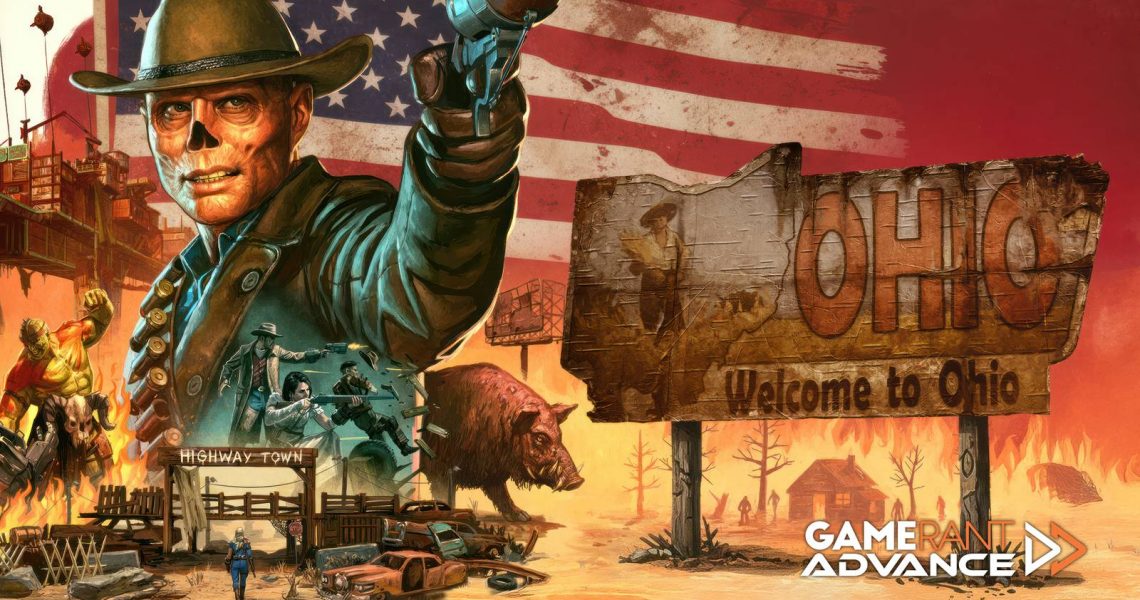
Fallout 76 Embraces Its Own Manifest Destiny with the Burning Springs Update
December is undeniably a great time to be a Fallout fan. Not only does Fallout 76‘s Burning Springs update drop on December 2, but also Fallout season 2 takes fans to New Vegas on December 17. Burning Springs will also expand its content over time, while Fallout season 2 will have episodic releases going into early February 2026. December is just the start of what should be a hot streak for the franchise.
Ahead of these releases, we spoke with Fallout 76 creative director Jon Rush and production director Bill LaCoste for Game Rant Advance about the Burning Springs update, bringing the Ghoul into the game world, and so much more, including a little tease for 2026. What’s clear from our conversation is how much these developers love the Fallout IP and hope to take that love for it even further with Burning Springs, and it’s also a good time to reflect on the growth of the Fallout IP as a whole.
Fallout’s Manifest Destiny Adds Another Wasteland
In 1776, a collection of thirteen British colonies came together to declare themselves the United States: a new nation of free and independent states with the right to govern themselves based on the notion that all men are created equal. It was a beautiful faith in their ability to create a new world. In 1997, Interplay Productions released the first Fallout game and kickstarted an IP based on a post-apocalyptic and retro-futuristic world that imagined something new, but destroyed, built upon the ashes of the broken American dream. It was a fantastic, over-the-top, dark world that twisted both the devs’ imagination and the fledgling USA’s fantasized world, where global nuclear war destroyed what was once a proud nation.
In the early 1800s, the fledgling United States began to expand with government land acquisitions like the Louisiana Purchase, while Bethesda fully acquired the rights to Fallout in 2007 and has, ever since then, expanded the IP in new, meaningful ways. The United States, under the notion of manifest destiny, would expand westward and eventually celebrate its success from “sea to shining sea.” And in 2025, Fallout 76 continues its expansion across Appalachia with the Burning Springs update, which takes the game into southeastern Ohio—a brand new state for the IP. Some day, too, Fallout may span the entire United States from wasteland to irradiated wasteland, but Fallout 76‘s addition of Ohio is just one step in its own manifest destiny.
Every State Represented Across Fallout
- California (first introduced in Fallout 1)
- Nevada (first introduced in Fallout 1)
- Oregon (first introduced in Fallout 2)
- Maryland (first introduced in Fallout 3)
- Virginia (first introduced in Fallout 3)
- Pennsylvania (first introduced in Fallout 3)
- Washington, D.C. (first introduced in Fallout 3)
- Alaska* (first introduced in Fallout 3 DLC)
- Arizona (first introduced in Fallout: New Vegas)
- Utah (first introduced in Fallout: New Vegas DLC)
- Massachusetts (first introduced in Fallout 4)
- Maine (first introduced in Fallout 4 DLC)
- Illinois* (first introduced in Fallout Tactics)
- Missouri* (first introduced in Fallout Tactics)
- Kansas* (first introduced in Fallout Tactics)
- Colorado* (first introduced in Fallout Tactics)
- Texas* (first introduced in Fallout: Brotherhood of Steel)
- West Virginia (first introduced in Fallout 76)
- New Jersey (first introduced in Fallout 76)
- Ohio (to be introduced in Fallout 76’s Burning Springs update)

*Alaska is just a simulation, but we’re counting it. Fallout Tactics and Fallout: Brotherhood of Steel are not clear-cut canon, but we’re counting them. The Fallout TV series has yet to venture into a new territory. Fallout 5 will likely introduce a new area; however, it’s uncertain if that will be the 21st+ state(s) or if Fallout 76/the Fallout TV show will beat FO5 to it.
The Fallout World Continues to Grow Beyond Just New Locations
Knowing Fallout 76‘s Burning Springs release date is just two weeks ahead of Fallout Season 2 may make you think the two are more connected than they are. However, according to Rush, “there isn’t a ton of opportunity for direct connections” or a need to work closely together when the two are at opposite ends of the timeline.
The Fallout 76 team does keep up with the material in the show, but the two happening so close is more of a happy accident than a result of meticulous planning. The ending of Fallout season 1 did directly inspire the Burning Springs update, though. As Rush continued,
“Seeing where Season 1 ended up, in the desert of what used to be Las Vegas, we wanted to offer a region that felt similar in Fallout 76. If you look at the regions on the Fallout 76 map, they’re all distinct–and this arid, desert hellscape was a climate we hadn’t explored yet. And at the same time, a nice tonal link to what viewers may experience in Season 2 of the show.”
From there, it made sense to expand the connection beyond just the deserts of Fallout‘s New Vegas and Ohio, but it’s not like Lucy from the show could just appear. However, The Ghoul makes perfect sense in the context of his history and story, and it’s more than a simple cameo. While Rush would not speak to The Ghoul’s motivations in Fallout 76, fans can expect it to be part of his story. He’s in Ohio for a reason, which is more than why most find themselves in Ohio, and players can expect to exchange some bounties and caps with him in the meantime.

The United States’ westward expansion was filled with good people believing in their own destiny, much like the Fallout 76 Vault Dwellers. But both encountered hardships and citizens who were only in it for themselves, which is something fans may be able to expect from The Ghoul as well.
Don’t Bet Against The Ghoul
One of the beauties of adaptations like the Fallout show is how it draws an audience back to the games. More than once, player counts in video games like the Fallout series have spiked after a successful television or movie adaptation. Many players will no doubt return to Fallout: New Vegas after this season, while plenty will continue their journeys in Burning Springs.
At the same time, it’s likely those who skipped out on Fallout 76 or never played the game will check it out for the first time. The Ghoul’s presence is no doubt going to be an attraction for new fans, so we had to ask about new or ongoing efforts for the new player experience. LaCoste’s short answer was “A LOT,” but he went on to explain the following:
- Fundamentals have been tightened (manual aim, V.A.T.S., combat balances), so playstyles are more welcoming.
- Early progression is easier to understand and more rewarding thanks to streamlined weapon mods and perk behaviors in Fallout 76.
- Players can also start at level 20, should they choose, with a backpack of supplies, weapons, armor, and a perk loadout.
Fallout 76 players can enter Burning Springs by crossing the Point Pleasant Bridge. The Burning Springs questline can be started by tuning into the Ohio Distress Signal at Level 30.
In summary, Lacoste said,
“All-in-all, we’ve created a more welcoming on-ramp that respects players’ time. New players can jump in, feel effective immediately, understand the game’s systems more clearly, and get them into other parts of Fallout 76 much faster—while still preserving depth for long-term progression.”

Burning Springs is Fallout 76’s Westward Expansion
Having a strong connection to the new season, having new iconic characters like The Ghoul, and a strong new player experience in Fallout 76 may do a lot to attract players, but it’s not enough if the supporting content falls flat. The Fallout 76 team knew that the Burning Springs update needed to be big, not just in the amount of content but in the quality thereof, and the team needed to bring something new to the table. That’s westward in Ohio, adding the 20th state to the franchise.
Mimicking the westward expansion of America, Fallout 76 is expanding its Appalachia map westward. Rush explained that the team was attracted to Ohio because “we’ve never really explored much of it” before saying, “The opportunity to expand our Appalachia map westward, coupled with the potential for new stories in that region, was very tantalizing to us as creators.”
Not only is Ohio tantalizing, but thematically appropriate. Fallout is at its best when deeply rooted in Americana, and there’s connective tissue in Fallout 76 expanding westward when the United States did so in the early 1800s. Manifest Destiny, government land acquisitions, the Homestead Act, and other historical decisions aside, this began the expansion of a fledgling nation into a world power. It could be easily argued that Fallout is already a recognizable power in the game industry, but growing and reflecting more of the Fallout world through new states can only elevate that notion.
It seems unlikely that Fallout 76 will one day expand to cover the entire US, but the IP might, and Fallout 76‘s inclusion of Ohio is just one step in its own Manifest Destiny for Appalachia. Beyond this destiny, it’s also important in how Fallout locations contribute to the story, with Rush saying,
“Like all locations set in the Fallout universe, a significant portion of them is derived from real-life locales. I think that lends a quality of authenticity to the unique settings and stories that would otherwise not feel grounded and familiar.”
Burning Springs is a Statement of Faith in Fallout’s Vision of Post-Great War America
Expanding westward was no easy feat, not for the United States or for Fallout (though of course one was probably much easier than the other). Burning Springs is the largest update since Wastelanders back in 2020. Many may be curious as to why such large updates don’t happen often, and the answer is as simple as expanding westward was for the United States. It took years because of various hardships, and building such content undergoes its own dramatic changes.
Building large-scale content, as seen in Fallout 76‘s Burning Springs update with a new region, new characters, new systems, new rewards, and new points of interest, dramatically changes the development pipeline. First, such a scope requires a higher level of cross-disciplinary work—even from day one. LaCoste explained that,
“From day one, there’s a deep ideation and concept phase focused on defining the region’s tone, identity, and ‘why.’ Why does this place exist? Who lives there? What makes it engaging and worth exploring? Those foundational decisions ripple outward and influence everything—character design, creature ecology, quest structure, environmental storytelling, and even the types of points of interest that make the space feel alive, or not alive! And then once all of that has been locked down, we schedule it all out and spend a good amount of time ensuring that all the interdependence lines up to ensure smooth development.”
What Does Ohio Look Like in This Fallout Pipeline
Ohio can get a bad rap, and that has evolved and changed in social media years, just like it has in real years. In 2022, the “Only in Ohio” meme grew due to the belief that weird things were happening in that state. Over time, that developed (or devolved) into modern slang where just “Ohio” means something is weird, strange, or cringe. But what is “Only in Ohio” or “Ohio” about Fallout 76‘s new setting?
The Fallout 76 team deeply believes that the inclusion of real-world places helps ground the universe. Starting out, Rush believed that Athens was “a must-have for the update” because “it was one of the first cities established in Ohio and dates back all the way to 1800. What’s more ‘Americana’ than that?”
And yet, this Ohio “survived” The Great War. Two ways this new location immediately stands out as Fallout‘s Ohio are the environmental disasters that plague Burning Springs, namely the Abaroxdyne Chemical Plant and Rust dust storm. Environmental poisoning from the former has turned the area into a wasteland with poisonous water, while a dust storm covers everything in a new toxin called Rust. Few can survive there, but adopting the update’s theme of “Might Makes Right” is The Rust King. Players can expect a few encounters with this new Super Mutant, while also visiting locations like Highway Town as the last pit stop for humanity.
It seems fans can expect more than just environmental disasters from Abaroxdyne, as Rush would speak to the team’s desires with these effects:
“The team had wanted to explore the idea that the Abraxodyne company was more than a dish detergent maker and possibly expose that some of their chemical manufacturing was being used for other secretive purposes. When combining those explorations with ‘the rust belt,’ we ended up with the environmental disasters seen in Burning Springs.”
Exploring Burning Springs
There’s a lot of content baked into Burning Springs. Beyond dealing with these environmental effects and the main story, Lacoste said they could enjoy the bounties, the new events, “maybe find some ‘Dirty Laundry’ along the way, discover all the new points of interest, fish, and find gorgeous new places to build their C.A.M.P.S.”
Rush on Bounty Hunting
“Once you arrive [at The Last Resort], The Ghoul will be conducting some business towards the back, and after a quick look-over, if he feels that he can make use of your unique skills, he will offer up some of their lower-level bounties that aren’t worth his time. These are called ‘GRUNT Hunts,’ and he has plenty of these contracts to offload, providing a steady source of experience, caps, and legendary items. A ‘Head Hunt’ is a special bounty hunting contract–it’s a Public Event, where everyone within earshot can join. The main target is as tough as they come, and players can’t go it alone!”
Rush on Gearin’ Up
“For ‘Gearin’ Up,’ the team wanted to play up the cool visuals of the armored Deathclaws. In the Burning Springs update, you end up fighting several of them, but for “Gearin’ Up,” they wanted to flip that idea around and place the focus on fighting alongside them instead. That idea, coupled with the unique environment of the Junkyard, makes up the core tenets of that event.”
Rush on Sinkhole Solutions
“For ‘Sinkhole Solutions,’ the team wanted to lean on the raw natural disasters of the area: sandstorms and fire. Rad Scorpions are just cool, so an automatic inclusion here. And the inclusion of the other creatures came about through internal playtesting. They found out that tortoises (Ogua) eat scorpions in real life, so the rest wrote itself!”
From Wasteland to Irradiated Wasteland: Burning Springs is the Next Step in Fallout 76’s Manifest Destiny
Fallout 76 has been out for seven years, and it has changed a lot. Many would consider it one of the better “redemption” stories in the industry, which began with Wastelanders back in 2020. Now far beyond that, Burning Springs is about expanding the world of Fallout 76 and, as such, taking the next step in its own Manifest Destiny. Appalachia still has a lot to offer Fallout 76, all while it adds to the vision of Fallout‘s America. At such moments, it’s also important to reflect on the past, present, and future.
From the past, it’s important to learn. When asked what the single biggest lesson over the past few years has been, Rush said, “Bethesda Game Studios has the best community in gaming! Over the past seven years of support and development, we have grown to understand our Fallout 76 community much more.” He continued,
“An important note we came to realize was that our players love to play in our Appalachia: the community’s Appalachia, the developer’s Appalachia…OUR Appalachia. Appalachia is the main character in our game, and players love to experience its stories and craft stories of their own through adventuring and building with their friends. In supporting a live service, our responsibility is to ensure that this main character always feels alive, and that the map is ‘sizzling’ with activity. This ends up being the backbone to the philosophy for all new features that go into Fallout 76.”

For the present, we asked about the various communities within Fallout 76. Not just those who play through the story or co-op, but the hardcore roleplayers, the theater groups, and everyone who has contributed to the game in their own unique ways, who use it to tell their own stories of the wasteland. As LaCoste said,
“First off, it’s been amazing to see the amount of roleplay that exists within Fallout 76. I’m always impressed by what the Wasteland Theatre Company has done and the friendships they have all formed, especially during the pandemic. Because of the roleplaying element that exists, we just try to keep providing great environmental storytelling and props through the Season and Atomic Shop that help reinforce new works by these groups. We have added sound stages, lights, cameras, and so many other items into the shop over the years to provide more avenues for these players to tell their own stories.”
And finally, the future. It’s hard to always think ahead because it is so important to be in the moment, and that moment is Fallout 76‘s expansion into Ohio with Burning Springs. But LaCoste promised that there’s more on the horizon:
“As Jon and I have said a lot recently, we want to add new systems to the game, but not forget about them in future updates, so look for major release with new content, but also expansions to fishing, bounty hunting, public events, and places like Skyline Valley.”
There’s no telling where Fallout 76 itself will go next, no telling where the Fallout show may go after New Vegas, and no telling where the Fallout games will take players next, but what’s always clear is how much care is put into all of it. Fallout 76‘s ‘westward expansion’ and the overall growth of the IP may be slow, but every team is committed to doing it right. Fans expect nothing less, and Bethesda Game Studios wants to deliver nothing less.

- Released
-
November 14, 2018
- ESRB
-
M for Mature: Blood and Gore, Drug Reference, Intense Violence, Strong Language, Use of Alcohol