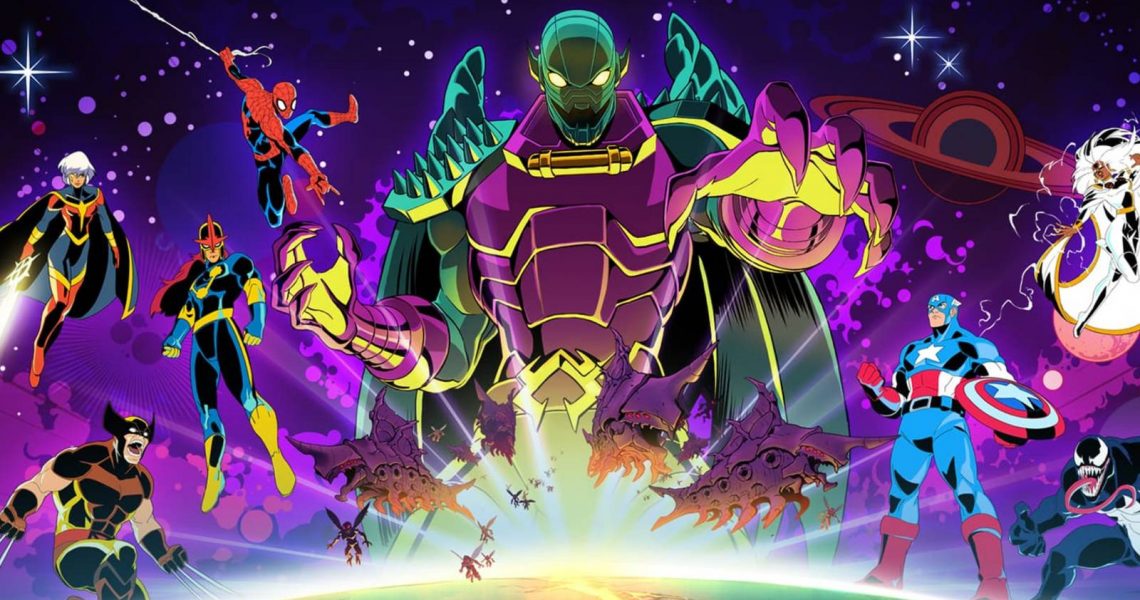
A Superhero Beat-em-up at Its Finest
The persistence of retro-influenced games in modern culture is fascinating, reflecting a widespread desire to, on some level, turn back the clock and abandon all the frills and glamor of contemporary gaming. Of course, there’s always the question of balance, as many old-school arcade games haven’t aged well despite their gleam in our collective memory. Not a lot of classically influenced video games get this balance right, but Marvel Cosmic Invasion most certainly does.
Marvel Cosmic Invasion doesn’t tell a subversive or experimental story, nor does it reinvent the wheel with respect to its genre conventions, but that doesn’t matter much. Players have access to a roster of 15 distinct heroes, each with their own spate of weapons and skills, available in both the story-based campaign and classic arcade modes. It’s not the most complex game out there, but it’s far more multifaceted than one might first assume: there’s a high skill ceiling for those willing to reach for it.
I was expecting to enjoy Marvel Cosmic Invasion—after all, it comes from Tribute Games, the studio behind 2022’s excellent Teenage Mutant Ninja Turtles: Shredder’s Revenge, which is a similar retro arcade throwback. But I wasn’t exactly expecting to be blown away by this Marvel adventure, which is every bit as good, if not a bit better, than its TMNT predecessor. It’s slick, stylish, smooth, and the best beat-em-up since Streets of Rage 4.
Marvel Cosmic Invasion Is Fun and Gorgeous

The Hero Roster Is Marvel Cosmic Invasions’ Beating Heart
Multiplayer beat-em-ups will often feature a wide selection of characters to play as, encouraging synergy and unique teamwork scenarios. For instance, Player 1 might assume the role of a tank character, slow-moving and heavy-hitting, while Player 2 may opt for a more agile playstyle. Marvel Cosmic Invasion builds upon this basic structural philosophy by making each of its characters truly novel, visceral, and refreshing. No two heroes feel the same to play—variety that goes far deeper than mere attack speed, DPS or other stat.
Some characters can parry, others can dodge; some can throw, while others have ranged attacks. Even within these broad-strokes mechanical concepts is a surprising degree of ingenuity. For example, She-Hulk and Phoenix can both throw enemies, but the former’s WWE-inspired moveset stands in stark contrast to the latter’s telekinesis-powered throws. Through this mechanical variety, Cosmic Invasion reveals its true depth, that being its wealth of choice, which ultimately leads to greater expression via gameplay.

In my early hours with the game, my “favorite” character would consistently get replaced by the next one I tried. There really are no weak links in the roster, and each hero has at least one gameplay quirk or unexpected move that makes them memorable. I haven’t walked away from Marvel Cosmic Invasion with a favorite character, but rather with favorite mechanics: simple but effective moves like Beta Ray Bill’s sustained Stormbreaker throw, or Phyla-Bell’s sword-based teleportation, are consistently fun to use, and transform seemingly pedestrian enemy encounters into graceful, vibrant comic book splash pages. Such encounters encourage and cultivate experimentation, but not so much that the game becomes impenetrable for more casual audiences.
No two heroes feel the same to play—variety that goes far deeper than mere attack speed, DPS or other stat.
Marvel Cosmic Invasion Is a Treat for the Senses
With Shredder’s Revenge, Tribute Games leaned hard into 80s and 90s aesthetics to create some wickedly captivating artistic works, specifically through environmental elements like skyboxes. Tribute has retained the same retro 2D art style for Cosmic Invasion, with relatively few fundamental changes, but the more bombastic context of its sci-fi story allows for far greater visual diversity. Cosmic Invasion features such distinct locales as Asgard, New York City, Wakanda, and the Negative Zone, and Tribute’s art team bats .1000 every time, navigating new themes and atmospheres with ease.

A strong, unapologetically Sunday-morning-cartoon soundtrack helps buttress each level’s tone. It’s perhaps not among the best video game scores ever, or even among the best of 2025, but it’s definitely beyond serviceable, providing an appropriate blend of clean synth beats, 808-driven throwbacks, and triumphant tracks to underscore the dynamism of each level. While it would have been nice to see the head-and-shoulders exceptionalism of the art design reflected in the soundtrack, it’s still a solid, foot-tapping accompaniment.
As Expected, Marvel Cosmic Invasion Is Short and Sweet

A lot of games try to cast a wide net, often with great results. Take a game like Stardew Valley or Hades: these sorts of titles keep you on your toes for dozens of hours, constantly expanding with compelling narrative and gameplay elements that evolve. In case it isn’t already obvious, Marvel Cosmic Invasion is absolutely not this kind of game. It has a short and by-the-numbers story, only two real game modes (campaign and arcade), and progression/unlockables that are surface-level at best.
It’s hard to consider this small scope and relative lack of ambition as hard knocks against Cosmic Invasion; it’s meant to be quaint, in a way. But the game is adapting Cosmic Marvel, a subset of comics that has historically had some of the most creative characters and stories of the medium, so it would have been nice to see it take greater risks in this regard. Marvel Cosmic Invasion‘s story is minimal, but worse, it’s forgettable. Many of the arcade games that inspired Cosmic Invasion have similarly stripped-back storytelling, but this can be excused by their arcade context: players gathering in public for short bouts of gaming probably don’t have the bandwidth for deeper or more complex stories. This is an external limitation that doesn’t apply to Cosmic Invasion, so while the lackluster story may be reminiscent of those arcade games of yore, it’s an homage that does more harm than good.
I feel similarly about Cosmic Invasion‘s boss fights. Some of these encounters are quite good, forcing the player to master mechanics like parrying to achieve success. However, there are other boss fights that feel more frustrating than fun: the game has a tendency to ratchet up the difficulty of a boss battle in the final third or so, but this can be such a dramatic change that it feels artificial. The worst offenders are the fights that devolve into chaos and visual clutter toward the end. Getting stun-locked because you can’t make out enemy attack patterns in the visual noise isn’t challenging; it’s annoying.
I wish that the game tried a little bit harder with its promising source material, and some boss fights could be a little more refined, but these are small gripes in the grand scheme of things. Tribute Games has made one of the best arcade throwback titles of the past several years, raising the bar once more, just as it did with TMNT: Shredder’s Revenge. Marvel Cosmic Invasion is a surprisingly nuanced, mechanical and visual banquet worth anyone’s time, whether they’ve gone in for beat-em-ups in the past or not. It’s an absolute joy.

- Released
-
December 1, 2025
- Developer(s)
-
Tribute Games Inc.
- Multiplayer
-
Local Co-Op, Online Co-Op
- Franchise
-
Marvel


- Fantastic, varied combat mechanics
- A strong roster of iconic Marvel heroes
- Electrifying 2D art design
- A bland and forgettable story
- Limited game mode variety
- Hit-and-miss boss battles
Marvel Cosmic Invasion launches on December 1, 2025 for Xbox Series X|S, PS4, PS5, Nintendo Switch, Nintendo Switch 2, and PC. Game Rant was provided with a Steam code for this review.