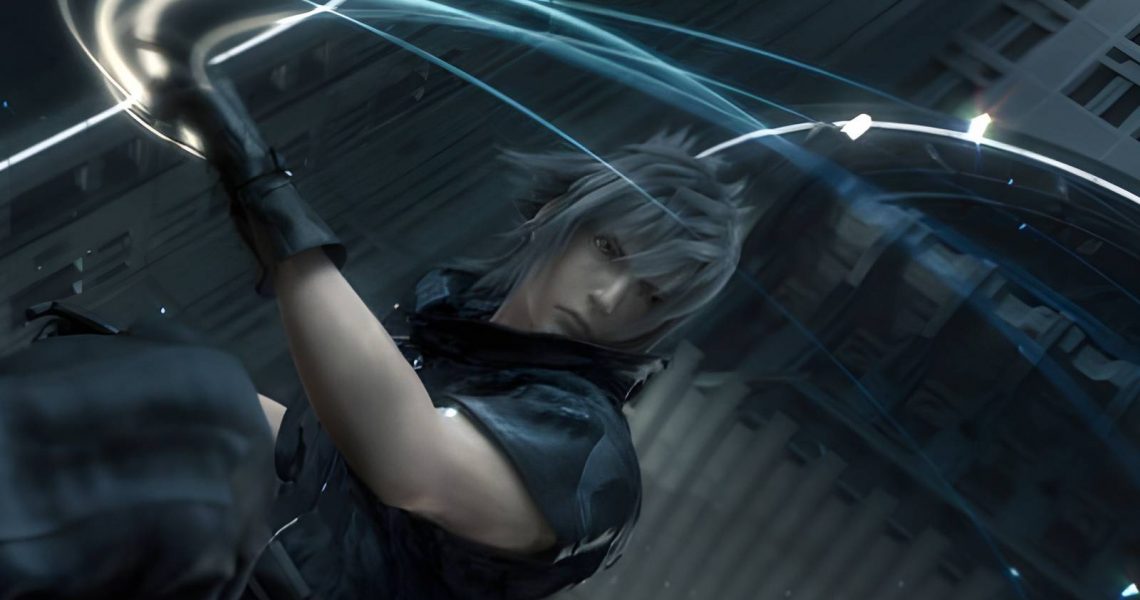
14 Years Ago, Final Fantasy Versus 13 Began Falling Apart and Led to Final Fantasy 15
Final Fantasy 15 may not be the best game in the series, but it certainly has its strengths. Flashy combat and likable characters have been enough to establish this particular Final Fantasy entry as a minor cult classic, despite some shallow combat mechanics, an iffy story, and a bland open-world, even by 2016 standards.
But everything that people love and hate about Final Fantasy 15 almost never came to be, for Noctis’ urban-fantasy adventure was once quite different. Originally called Final Fantasy Versus 13, the early days of Final Fantasy 15‘s development envisioned the final product as a PlayStation 3-exclusive action-RPG led by Kingdom Hearts puppeteer Tetsuya Nomura. But the speedy forward crawl of technology, combined with notable internal shakeups and all-too-common development woes, resulted in a dramatic mutation. Indeed, while Final Fantasy 15 is a fairly interesting game, its development story is downright fascinating, and delving into it reveals useful insights into the complexities of game development, especially on the scale of a franchise like Final Fantasy.
Final Fantasy Versus 13 and Fabula Nova Crystallis

Fabula Nova Crystallis
Final Fantasy Versus 13 was intended to be a part of the broader Fabula Nova Crystallis mythology, which is described as a sort of loose connective tissue between games like Final Fantasy 13, Final Fantasy 13-2, and Final Fantasy Agito. According to Final Fantasy 13 director Motomu Toriyama, the Fabula Nova Crystallis games can be conceptualized as a sort of epic fairy tale: they share the same mythos and deities, but their plots are tangentially connected at best.
In this original draft, Noctis was still written as the prince of Lucis, enemy state of Niflheim, but the magical crystal in the former’s possession was said to be more closely tied to the crystal lore of Final Fantasy 13. The epic-scale political intrigue and warfare appears to have been a core part of Final Fantasy 15‘s story from the very beginning, though its days as Final Fantasy Versus 13 would have seen a very different plot, and significant characters and locations would ultimately be reworked for the final game. For instance, Luna’s role was originally meant for a character called Stella, who appeared in Versus 13‘s first reveal trailers.

Final Fantasy Versus 13 Was in Development Until 2011
Though it was first revealed in 2006 with a cinematic trailer, it’s not exactly clear when development of Final Fantasy Versus 13 began in earnest. Given its relationship to Final Fantasy 13, it’s widely believed that full-scale development on Versus 13 began after the former launched in 2009. Whatever the case, 2009 was the year that Square Enix first showed in-engine footage of the game, though then-director Tetsuya Nomura said that this was more like a proof-of-concept, a snippet purpose-built for presentation and not intended for the final build of the game.
Versus 13 gameplay footage shared in 2011 depicts an action-RPG in the vein of Kingdom Hearts and Final Fantasy 7: Crisis Core: enemies are presented in scripted encounters, and combat operates via a Command menu on the left-hand side of the screen. Interestingly, it appears that players would have been able to switch between party members during combat, and each of them would have featured a different combat style. For instance, Prompto would have been controllable, able to use a handgun to shoot enemy weak points and even trigger environmental hazards.
Tetsuya Nomura wanted Versus 13 to be a seamless open-world, despite it being a companion piece to Final Fantasy 13. To this end, the Luminous Studio engine, later renamed simply Luminous Engine, was created, unveiled at E3 2012. As it would happen, this was right around the time that another major technological milestone would redefine Final Fantasy Versus 13‘s development.
Luminous Studio marked a considerable technological leap forward for Square Enix and Final Fantasy, allowing for much more detailed environments, and especially detailed character models.
The PlayStation 4 Played a Major Role in the Creation of Final Fantasy 15
In 2011, Square Enix leadership would be shown the PlayStation 4 for the first time, prompting them to reconsider Final Fantasy Versus 13, which was still slated for a PS3-only release. Moreover, although it had been in the pipeline since 2006, progress on the game had been slow, with even Nomura himself often appearing uncertain about its release horizon. The combination of Sony’s new hardware, a sporadic development timeline, and the ambitious Luminous Engine led to the decision to sever the connection between Final Fantasy Versus 13 and Final Fantasy 13, turning the former into Final Fantasy 15, a definitive, mainline entry in the broader series.

During this process, Final Fantasy 7: Crisis Core director Hajime Tabata assumed the role of co-director alongside Nomura, who eventually ceded full control of the project to former. Reportedly, Tabata worked closely with Nomura to ensure that essential elements like the main cast would remain intact, before embarking on a ruthless editing campaign. Much of Versus 13‘s story was fundamentally altered, and its connection to the other Fabula Nova Crystallis games was significantly reduced. The game’s scale would go on to inform its identity as a standalone, mainline FF release.
Whether all of this back-and-forth was worth it in the end is debatable, but it certainly makes for an interesting development story. One particularly revealing insight offered by Tabata is about the issues of revealing a game too early. The director has said that he thinks it was a mistake to reveal Versus 13 in 2006, as this resulted in it being burdened by audience expectations, making for a messier development process. Indeed, it’s fascinating to trace the long-winded creation of FF15 all the way back to 2006, as it demonstrates how factors like communication, clarity, and leadership can have a far greater impact on a game’s development than financial resources, which were never among Versus 13‘s biggest problems, by all accounts.