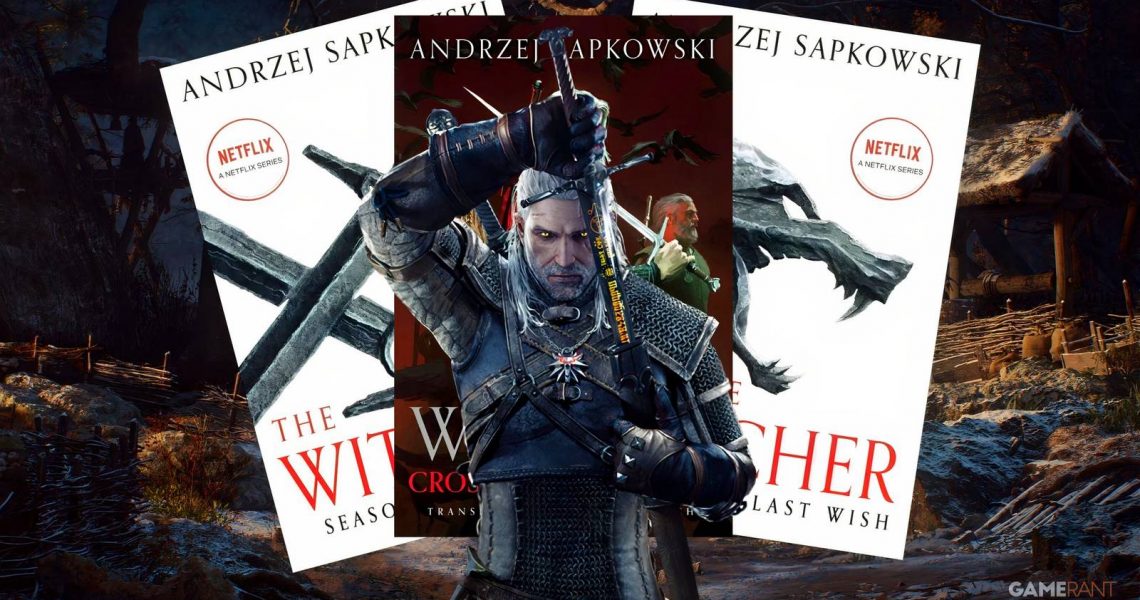
What Order to Read The Witcher Books
If you’re diving into The Witcher books for the first time, figuring out the reading order can be more deceivingly complicated than expected. Between short story collections, a five-book saga, standalone entries, and newer installments, the series isn’t structured like a typical or linear fantasy franchise. Even longtime fans who have been glued to the series since the ’90s may hesitate to decide where someone should start.
The good news is that there is an optimal way to read the books. With the right order, readers can preserve emotional payoffs, character arcs, and worldbuilding. So whether you’re coming from The Witcher games, the Netflix show, or just pure curiosity, this order balances narrative impact with recent releases, and also delivers the most cohesive and rewarding Witcher experience. It will be an experience, at the very least, that mirrors how the world evolved around Geralt.

The Witcher: The Strongest Characters, Ranked
From Geralt to Ciri and Triss, The Witcher is packed with powerful characters who can accomplish incredible things.
Start With The Witcher’s Foundations
Before jumping into the main saga, readers may want to get acquainted with the world, its lore, and the rules. These entries establish not only The Continent as a setting, but Geralt’s worldview, relationships, and the morally gray tone that will accompany the reader throughout.
Balance the critic averages
Balance the critic averages
Easy (6)Medium (8)Hard (10)
1. Crossroads of Ravens
Crossroads of Ravens is the newest entry in The Witcher universe. Published in 2025, it acts as a prequel centered on an 18-year-old Geralt who has just begun life on The Path. Fresh out of Kaer Morhen, he’s inexperienced, uncertain, and still forming the philosophies fans associate him with.
Although it wasn’t the original starting point for longtime readers, it is the best one for modern fans. It is a fitting entry point thanks to its accessibility and fresh perspective on Geralt’s earliest years.
2. The Last Wish
Historically, this is where most readers have begun. The Last Wish is a collection of short stories framed by Geralt, who is recovering in a temple and reflecting on his past adventures. Most importantly, it establishes Geralt’s relationship with Yennefer. Additionally, as this was the original entry-point into the Witcher universe, readers will also find some of the groundwork for the political and social landscape of the Continent.
3. Sword of Destiny
The second short story collection builds directly on The Last Wish while planting the seeds for the main saga. Though episodic in nature, it begins tightening the narrative threads that later novels pull together. By the end of Sword of Destiny, readers are fully prepared to enter the central Witcher saga. Sword of Destiny also introduces Ciri, a core character for both the main saga of books and the upcoming protagonist of The Witcher 4.

CD Projekt Red’s Witcher Has an Ace Up Its Sleeve That May Never Get Played
The Witcher’s future is packed tighter than a full gwent deck, and one possible adaptation, while novel and intriguing, is improbable.
The Main Witcher Saga
Once readers have completed the short stories and prequel, they are ready to dive right in. The series now shifts into a traditional multi-book fantasy arc. These novels follow Geralt, Ciri, and Yennefer in a linear way through war, prophecy, and shifting political alliances.
4. Blood of Elves
The first full novel marks a structural shift from episodic storytelling. It focuses heavily on Ciri’s training, both as a Witcher and in magic. The growing tensions across the Continent shape the background of the novel, as Nilfgaard and the Northern Kingdoms both have potential uses for Ciri.
5. Time of Contempt
Political tensions erupt into open conflict between Nilfgaard and the Northern Kingdoms. A catastrophic mage coup fractures the central trio, sending each character on a separate path. None of the three can be certain they will ever see each other again in the aftermath, particularly as the war continues to escalate.
6. Baptism of Fire
This entry in the saga follows Geralt recovering from his injuries and gathering allies and connections while looking for Ciri. New allies join the journey, including fan favorite Witcher companions who highlight the books’ themes of loyalty and chosen family. Despite the war-torn setting, this has to be one of the saga’s most character-driven installments. Notable characters include:
- Zoltan Chivay: A dwarf mercenary captain accompanying refugees from the ongoing war with Nilfgaard. Zoltan proves a fast friend to Geralt through the rest of their journeys together.
- Cahir: A knight of Nilfgaardian origin in pursuit of Ciri. He initially follows from a distance, and is eventually welcomed into the group after revealing he has been having prophetic dreams of Ciri which Geralt has also experienced.
- Milva: A human archer who guides rebel bands of elf Scoia’tael through the forest. She joins Geralt on his journey reluctantly, but ultimately proves to be a key part of the group.
- Regis: Initially treated with due suspicion, Regis the high vampire lends Geralt and his companions invaluable medical aid throughout their travels. Notably, Zoltan and Regis both make appearances in The Witcher 3: Wild Hunt.
7. The Tower of the Swallow
The narrative splinters into multiple threads, but Ciri’s story takes center stage. Ciri is pursued by powerful enemies into increasingly surreal and dangerous territory. Simultaneously, Geralt and Yennefer continue their efforts to find Ciri, who they have separately concluded has been kidnapped by the wizard Vilgefortz.
8. The Lady of the Lake
The final novel in the main saga delivers the emotional and thematic payoff the series has been building toward. For many readers, this is the true ending of The Witcher.
9. Season of Storms
Season of Storms is a standalone novel set during the early timeline of The Witcher. It chronologically fits between stories from The Last Wish. However, despite its placement during publication, it contains spoilers and thematic elements that assume familiarity with the entire saga. The novel follows Geralt on a self-contained adventure. Because of its references and tonal differences, it works best as a reflective epilogue rather than a starting point.