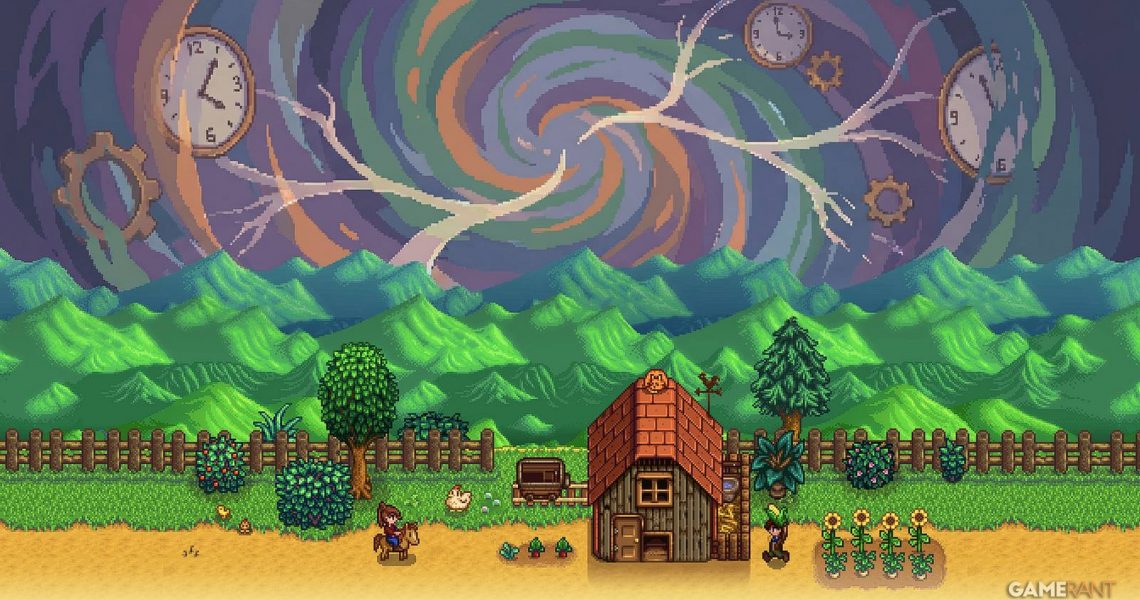
Why Stardew Valley’s Uncertain Future Is Actually a Good Thing
“It might not ever be done,” says Eric “ConcernedApe” Barone of his hit farm life sim Stardew Valley. In a recent interview with IGN, the developer described his work on the game as ongoing with no end in sight, as just when he thinks he has reached a stopping point, he feels obligated to return to it. Much of this, he says, is due to the fact that people keep playing Stardew Valley, and he considers his continuous contributions towards the game his way of “connecting to the rest of humanity.” More than anything, he sees the farm life sim as an endless pool of possibilities, where it’s less about adding more content and more about expanding what is already there. The only thing is, not even he knows where all of that will end up—or whether it will end at all.
As ambiguous as it is, Stardew Valley‘s biggest strength is and always has been its uncertain future. As Barone continues to leave the days ahead of the game open-ended, that extends its life, its relevance, and its legacy, slowing its path toward becoming a relic and enlarging its territory as one of the most influential indie games in the industry. Despite now being a decade old, Stardew Valley continues to see player-count peaks of tens of thousands on Steam alone, with its biggest updates generally making those numbers soar even higher. Ultimately, this is because Barone is committed to improving the game, not merely through bug fixes and technical patches, but by treating it as a living thing rather than a finished product.
The Unknown Keeps Stardew Valley’s Developer and Community Imaginative Rather Than Impatient
One of the biggest mistakes any game developer can make is promising things that it either can’t fully commit to or features that couldn’t possibly match the expectations of fans. There are some nuances to that, of course, as gamer expectations have been known to be out of hand more than a time or two. However, the better route might nonetheless be to instead leave room for flexibility rather than locking a game into a future that may no longer make sense once it gets there. By keeping plans a bit up in the air as far as players are concerned, a developer retains the freedom to follow inspiration where it actually leads instead of where a roadmap says it should go.
As ambiguous as it is, Stardew Valley‘s biggest strength is and always has been its uncertain future.
In Stardew Valley‘s case, that approach has paid off for Eric Barone. Rather than establishing an endpoint for the game or making a big promise like a sequel, the developer has allowed the game to grow organically, responding to how people actually play it and what continues to draw them back to their farms even a decade later. That might make the game’s future vague, and it doesn’t inherently exclude Stardew Valley from controversy or criticism, but it does, more often than not, tend to avoid the disappointment that comes from overpromising. It also helps keep the game’s community imaginative about the possibilities rather than impatient about the promise. And if anything has proven to be immensely true of modern gaming, it’s that a game often lives or dies by expectations.
Stardew Valley’s Future Is Filled With Possibilities, Some of Which Barone Has Already Contemplated
But while Barone hasn’t made any major promises about the game’s future, that hasn’t stopped him from contemplating it. In the same interview with IGN, Barone briefly mentioned ideas like a “Stardew Valley Classic,” which would essentially strip the current game of its updates and take it back to its 1.0 roots. The idea would be to give longtime Stardew Valley fans back some of the friction they experienced when the game first came out, as points of frustration still have a way of endearing players to a game just as much as its comforts—even if those rough edges are no longer practical for a modern audience.
Barone did clarify that it would be hard for him to take Stardew Valley back to 1.0, simply because there are so many updates that have added “meaningfully good things to the game.”
Another possibility Barone has considered is a Stardew Valley sequel. In fact, he actually started working on a sequel at one point before making the decision to move over to his next game, Haunted Chocolatier. The main thing preventing him from working on a Stardew Valley 2 at the moment is that he’d want to make it different enough to justify its existence, not to mention the time he already feels obligated to spend on Haunted Chocolatier would be divided even more than it already is. Nevertheless, ideas like this are possible thanks to the developer’s view that the game won’t be done until its players are done.
Stardew Valley’s Uncertain Future Protects Haunted Chocolatier From Being Treated Like “Stardew With Chocolate”
From the get-go, Haunted Chocolatier has been labeled something along the lines of “Stardew with chocolate,” simply due to how similar the two games look to one another. To be fair, the game’s Stardew-like visuals and the lack of explicit details about pretty much anything else do somewhat justify that label—though not in Barone’s eyes.
Something the developer admits has been a “huge struggle” for him is walking the line between making the game he wants to make and doing his best to make sure people are actually going to like it. In other words, he understands that fans are likely expecting Haunted Chocolatier to be the next Stardew Valley, and he is concerned that they’ll be disappointed if it’s not. However, Haunted Chocolatier doesn’t need to be the next Stardew Valley as long as the original is still being expanded, which is yet another reason why its open-ended future is one of the best things for a developer like Barone.
If Stardew Valley were to end at some point, it would effectively need a replacement, as fans would call for one and ConcernedApe would undoubtedly want to continue working. In that context, Haunted Chocolatier would be that replacement. But since Barone has developed a team to help him continue growing Stardew‘s legacy while he devotes more time to his next game, it’s possible the two could exist in the same world and both be successful, rather than the latter replacing the former. In that world, Stardew Valley can be the only Stardew Valley, giving space for Haunted Chocolatier to make a name for itself.
Haunted Chocolatier doesn’t need to be the next Stardew Valley as long as the original is still being expanded.
So, with Stardew Valley still evolving in the background and no firm grasp on when that evolution might conclude, Haunted Chocolatier‘s development is afforded some patience. Barone doesn’t need to rush it to release, nor does he need to market it as a grand next step for an audience waiting on the edge of closure. Instead, it can take shape at its own pace, while Stardew continues to serve the community that made his work possible in the first place. That overlap turns what could have been a handoff into a coexistence, where one game’s uncertainty creates breathing room for the other to grow.
In the end, by refusing to draw a hard line under Stardew Valley, Eric Barone has kept it alive in a way that few long-running titles, even live-service games, manage to sustain. The uncertain future of Stardew Valley has allowed it to grow alongside its community rather than ahead of it, while also giving Barone the creative space to explore new ideas without dragging the weight of expectation behind him. As long as players continue to return and Barone continues to feel inspired, Stardew Valley will endure. And that actually makes the upcoming release of Haunted Chocolatier even more exciting.

- Released
-
February 26, 2016
- ESRB
-
E for Everyone (Fantasy Violence, Mild Blood, Mild Language, Simulated Gambling, Use of Alcohol and Tobacco)
- Developer(s)
-
ConcernedApe
- Publisher(s)
-
ConcernedApe