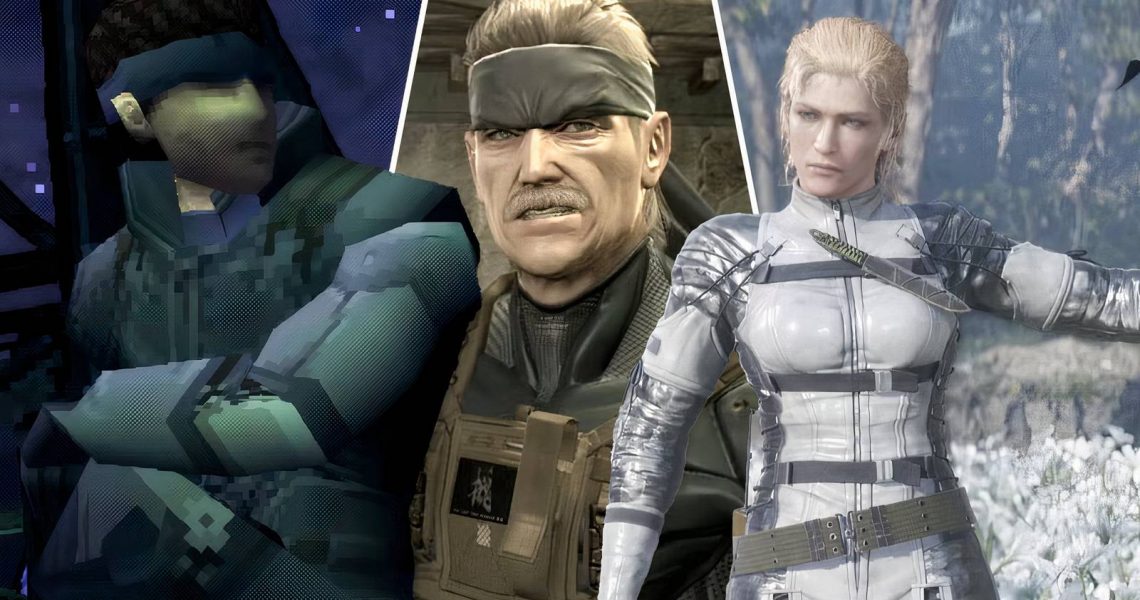
Metal Gear Games With The Best Stories
In 1987, Hideo Kojima and Konami unleashed Metal Gear, and the gaming world has never been the same. Along with spearheading and evolving stealth mechanics, the franchise is famous for its storytelling, particularly once the brand changed to Metal Gear Solid. Although prone to the occasional overwritten scene or convoluted plot thread, this series has a long history of brilliant stories, with nearly all the main entries excelling in this area. The overarching narrative can be difficult to follow at times, but the games weave a tapestry defined by ambitious cutscenes, smart comedy, and unforgettable characters.
Touching upon themes that deal with politics, philosophy, and war, Metal Gear serves as a prime example that games can contextualize violence in a way that enhances the overall experience. While there have only been five numbered Metal Gear Solid games, the series stretches far beyond that point, thanks to spin-offs, re-releases, and the pre-Solid releases. We have a lot of dialogue to get through, so let’s highlight the best stories in the Metal Gear games.
While the original games were good for their time, Metal Gear just cannot compete with the Metal Gear Solid era.
Who’s That Character?

Identify the silhouettes before time runs out.
Identify the silhouettes before time runs out.
Easy (7.5s)Medium (5.0s)Hard (2.5s)Permadeath (2.5s)
A Neat Spin-Off
A brutal hack-and-slash game developed by Platinum Games, Metal Gear Rising was a pretty big deviation from what fans usually expect from a Metal Gear game. The game originally began development at Kojima Productions, but in 2011, Kojima handed it over to Platinum Games after realizing they were a better fit for what he envisioned. The result was a fun action RPG that is one of Platinum Games’ hardest entries.
The game is set four years after the events of Metal Gear Solid 4, and follows Raiden’s mission to stop Desperado from causing global instability. The game focuses heavily on Raiden’s own identity crisis as a cyborg and his past as a child soldier. The themes are all very Metal Gear, but the game isn’t considered canon. Its story is fine, but it takes a backseat to all the cyborg-slicing action, meaning it gets the bottom ranking here. It’s still way better than Metal Gear Survive’s story, though.
Surprisingly Good
Before the PSP came along, portable consoles had a reputation for delivering a somewhat watered-down experience. Games like Metal Gear Solid: Portable Ops, one of the best PSP stealth games, proved that Sony’s little handheld could deliver a full AAA experience. The game had all the hallmarks of a standard Metal Gear game: great gameplay, impressive cutscenes, and a mind-bending story.
Unfortunately, the game’s plot works against it. Set in 1970, six years after Metal Gear Solid 3, it follows Naked Snake after he’s captured by a rogue FOX unit and escapes. The story explores themes of loyalty, betrayal, and the origins of Big Boss’s ideologies, but gets bogged down by the small details. Metal Gear games are known for their convoluted stories, and Portable Ops is one of the best examples of this. There are so many characters and so many references to other games that fans need a PhD in Kojima to follow it all. The game’s story wasn’t bad, but sometimes, less is more.
Now, In Another Metal Gear Universe…
Except for Ghost Babel and some mobile releases, Metal Gear Acid and its sequel might be the most forgotten entries in the series. Besides never coming out on home consoles and remaining PSP exclusives, the games’ obscurity could also be credited to their deck-building movement and combat system, which just comes across as cumbersome at first. Metal Gear Acid also takes place in a separate universe, meaning nothing in it is canon to the mainline entries; consequently, most people might just opt to skip these two entirely.
While nothing matters to the core series, that does not mean Metal Gear Acid does not feature memorable storytelling, with the first game being particularly great in this area. The game explores Snake beyond his in-universe role as a soldier, almost taking a meta approach in dissecting his character. The story is messy and chaotic on purpose, as it reflects Snake’s disoriented state and the unreliable information that is constantly fed to both the protagonist and players.
A Demo With A Story
Even for Kojima, Metal Gear Solid 5: Ground Zeroes was a really weird game. In a lot of ways, it felt like a glorified tech demo that fans were expected to pay for. Except, demos don’t normally have their own stories. Set in 1975, Ground Zeroes follows Big Boss as he sneaks into a U.S. black site in Cuba in an attempt to rescue Chico and Paz. Snake manages to rescue Paz but discovers too late that she has a bomb inside of her, directly leading to the events of the main game, The Phantom Pain.
For a glorified demo, it has one of the darkest Metal Gear endings, and stars some of the series’ most popular heroes and villains, including Skullface. The whole thing is too short though, and the story is heavily watered down by the need to replay it multiple times to unlock everything. It’s also possible to jump into Metal Gear Solid 5: The Phantom Pain without playing Ground Zeroes, making the whole thing feel more than a little pointless.
Forever Unfinished

Metal Gear Solid 5 The Phantom Pain

9/10
- Released
-
September 1, 2015
The Phantom Pain’s low ranking here might be controversial to some. After all, it is easily one of the best Metal Gear games, and its story has lots of highlights. Set in 1984, the game continues the tale of Big Boss and the Diamond Dogs following his recovery from a coma brought about by the events of Ground Zeroes. The Phantom Pain features one of the best story twists ever seen in a game, and hits all the right notes for a big-budget Metal Gear entry.
In fact, in a perfect world, Metal Gear Solid 5 would probably have had the best story of the entire franchise. All the ingredients are there. Unfortunately for everyone, Kojima and Konami had a falling out during the game’s production and the rest is history. The game was released in an obviously unfinished state, and its almost-amazing story just… ends, abruptly. Imagine if Avengers: Endgame had ended just before Iron Man clicked his fingers. That’s kind of how Metal Gear Solid 5 ended. Almost ten years on, fans are still rightly sore about it.
Still Working It Out
Asking a Metal Gear fan about Metal Gear Solid 2: Sons of Liberty’s story is an awesome way to watch someone squirm. They’re likely to tell you it’s one of the hardest Metal Gear Solid games (it is) and that it has one of the franchise’s best stories (it does). Ask them what the story is about, though, and it’s likely to cause some discomfort.
That’s because the game’s story is almost unbelievably complex and hard to follow. It starts with Solid Snake attempting to stop a new Metal Gear on a tanker, but then jumps forward two years to focus on a new character, Raiden, as he infiltrates the Big Shell facility to rescue the U.S. President from terrorists. Terrorists led by Solidus Snake. From there, things only get weirder, as Solid Snake turns up again and a really difficult-to-explain conspiracy involving The Patriots is revealed. If players can follow it, the game’s story is enjoyable, but it’s not easy to keep up with, and most players will likely need multiple playthroughs to catch everything.
Pure Fan Service
We often talk about fan service as if it’s a bad thing, but that’s not the case with Metal Gear Solid 4. Starring an old Solid Snake, the game had to wrap up the franchise’s story in an interesting way. It follows Old Snake as he goes on one last mission, hunting down Liquid Snake and Revolver Ocelot while facing off against the Patriots, an AI system controlling global affairs.
The game’s story peaks with an up-close and personal brawl between Old Snake and Ocelot that feels like pure fan service. Its ending, with Old Snake visiting a graveyard only to bump into Big Boss, wraps up the franchise’s entire story surprisingly neatly, while leaving room for more installments. The story’s only problem is that it’s almost impossible to follow for newcomers and relies on cut scenes that would test a monk’s attention span. That being said, the game thoroughly deserves fourth place here just for managing to tie up the majority of the series’s loose ends.
Filling In The Gaps
When it comes to Metal Gear’s overarching storyline, there’s really no such thing as optional content. Kojima’s style of storytelling demands that gamers play every entry if they’re going to be able to follow everything. This is perfectly summed up by Peace Walker.

What is the Best Order to Play the Metal Gear Games?
Hideo Kojima’s Metal Gear franchise is storied and complex, which may prompt newcomers to wonder what the best entry point is.
Peace Walker introduces some of the best Metal Gear characters and does an excellent job of explaining Big Boss’ slow descent into villainy. As he uncovers a CIA plot to control Latin America through nuclear deterrence, the original Snake comes to realize maybe there’s a “better” way. For anyone wanting to understand Big Boss’ motivations, Peace Walker is pretty much a mandatory play, as it sets the stage for both Ground Zeroes and The Phantom Pain.
In The Beginning

Metal Gear Solid


- Released
-
October 20, 1998
- ESRB
-
M For Mature 17+ Due To Blood and Gore, Suggestive Themes, Violence
Ok, so technically, Metal Gear Solid on the PlayStation wasn’t the first Metal Gear game, but for most fans it might as well be. It tells the story of Solid Snake, a soldier tasked with infiltrating a nuclear weapons facility on Shadow Moses Island in Alaska that had been infiltrated by terrorists. These terrorists, led by Liquid Snake, and part of FOXHOUND, will launch a nuclear strike if Solid Snake can’t stop them.
One of the best games of the 90s, the original Metal Gear Solid proved video games could have meaningful stories. Compared to later games in the franchise, its story was easy to follow and wasn’t bogged down by the kind of unnecessary details that plagued later entries. Metal Gear Solid laid the foundations for something truly special while still having an enjoyable story of its own.
Simply The Best MGS Story
It’s difficult to sum up just how impressive Snake Eater’s story is. It’s where the franchise’s narrative officially begins, and begins with Naked Snake’s mentor, the Boss, screwing him over and allying herself with the Soviet Volgin. It’s a tale where the original Snake loses everything but chooses to fight for everything he’s lost. Big Boss might be a villain, but in Metal Gear Solid 3, he’s still a hero.
Snake Eater is an amazing espionage thriller full of twists and turns, backstabs, and brilliant cut scenes. Most impressively, as winding as its story is, it’s relatively easy to follow; something that can’t be said for other entries. Snake Eater works as a story on its own while also serving as an awesome prequel for the rest of the series. If there’s one story in the franchise that players shouldn’t miss, it’s Snake Eater.
Metal Gear Solid Delta: Snake Eater is a very faithful adaptation of the 2004 classic, so it also ranks in the top spot.

Best Characters Created By Hideo Kojima, Ranked
Hideo Kojima is one of the greatest auteurs in video games, and with his incredible games come even more incredible characters.