Octopath Traveler 0 Review
Octopath Traveler 0 wasn’t my first experience with an Octopath title. Upon starting a new game, my time with the previous entries made this one like riding a bike—a beautiful bike with a well-oiled chain, but a bike nonetheless. So much about it felt familiar, like an everyday routine that comes so naturally you could probably do it in your sleep. To clarify, Octopath Traveler 0 never put me to sleep or anything (though its long and frequent story segments did threaten to at times). It just felt somewhat ubiquitous, very business-as-usual in a lot of ways. Yet, it never failed to surprise me, for better or worse.
One moment, I was spending a few slow minutes rebuilding the ruined town of Wishvale from the charred ground up, and the next, my jaw was on the floor after being placed there by some of the darkest story beats I’ve ever witnessed in a JRPG. It turned out that contrast like that is a major theme in the game, not necessarily narratively but structurally. A striking story undermines itself by talking too much, choices are a facade offering only the illusion of agency, and the most epic battles offer less-than-epic rewards. In the end, Octopath Traveler 0 settled somewhere between compelling and inconsistent, never quite reaching its full potential yet never losing what makes the series so captivating.
Octopath Traveler 0’s Story Is Dark, Gritty, and Exceedingly Long

When I first learned that Octopath Traveler 0‘s story could potentially reach 100 hours in length, I refused to believe it. However, after playing the game, I can see why. The Octopath series has always been about telling a story, but that has never been truer than in Octopath Traveler 0. In this entry, the story sequences are long, frequent, and often feel as though they have little regard for gameplay. Fortunately, though, the story has the kind of depth Octopath Traveler 2 redeemed the first game for, making those story beats feel worth sitting through more often than not.
The premise of Octopath Traveler 0 is fairly derivative of classic fantasy archetypes, with some Legend of Zelda themes thrown in there and even a dash of The Lord of the Rings‘ plot devices. Unlike previous games in the Octopath Traveler series, the latest lets players create and customize their own character, which ultimately makes the story hit just a bit more personally, but only just a bit. After the protagonist’s home of Wishvale is destroyed, they set off in pursuit of the three villains behind the attack. Each of these tyrants represents a corrupt extreme of a core human desire—wealth, fame, and power—and each one possesses a divine ring that can fulfill the desires of the one who wields them.

Despite having familiar roots, the story of Octopath Traveler 0 is very engrossing. Every one of the characters is interesting, and that is especially true of the villains. On that note, Octopath Traveler 0 is immensely darker than its predecessors, with plenty of story beats that I never saw coming due to the sensitive nature of topics they cover. Most of these come from the story’s antagonists, who are some of the most evil beings I’ve ever seen in a video game. Whereas so much of a villain’s wickedness is implied in other stories, it’s put on full display in Octopath Traveler 0, and it doesn’t hold back one bit. Ultimately, this makes pursuing each one of them all the more justified, and grants more credibility to the central conflict in the game.
While it’s worth experiencing, Octopath Traveler 0‘s story is exceedingly long, but that has little to do with the amount of time you actually spend playing. The bulk of that length comes down to how frequent and lengthy the game’s cutscenes are should you keep them at their default speed. Setting them to fast-forward mutes the dialogue, but most of the voice acting in Octopath Traveler 0 feels lifeless and forced anyway. Most times, it sounds like someone reading from a script and trying too hard to change their voice for it to be believable, and I personally found that speeding things up helped me stay more immersed in the narrative than letting it play out at its default speed.

In spite of its length, Octopath Traveler 0‘s story does an excellent job of keeping you on the edge of your seat, whether with its sheer intensity or its plentiful twists. There is almost always a new revelation waiting at the end of a plot thread, many of which shed new light on the game’s most prominent characters. As such, I never grew tired of the story itself, only how often it intruded on me actually playing the game.
I can’t count the number of times a 5-minute cutscene would play out, only for me to quite literally take a few steps after and trigger yet another lengthy cutscene. In fact, there were several instances where I would run from one side of a town to the other to reach my story objective, watch a cutscene, and then be sent back to the town entrance after, only to have to run back to the same location on the other side of town to trigger the next cutscene. In essence, Octopath Traveler 0 plays out more like a visual JRPG novel that you occasionally get to interact with.
Wishvale Is the Star of Octopath Traveler 0—When It’s Allowed on Stage

The illusion of choice is still a problem in Octopath Traveler 0, just as it has been with the previous games. There are frequent moments throughout the story where you’re presented with a choice that sounds like it should mean something, but the outcome is always the same regardless, even if the road to get there is paved with a slightly different stone. But the biggest issue with this design philosophy is how it affects Octopath Traveler 0‘s newest (and best) addition to the series: Wishvale.
For the first time in an Octopath game, players are treated to a cozy side activity with town-building and management mechanics in rebuilding the ruined village of Wishvale. As a fan of cozy games like Stardew Valley, I found this to be one of the most fulfilling aspects of the game, and not just for what I could do with it but for how it served as a relaxing break from the thematic extremities of the main story. In Wishvale, everything slows down, even the music, as it allows you to go at your own pace, complete with the sound of a babbling brook nearby. Here, players can build homes, businesses, a farm, a ranch, and more, all of which can be lived in and run by NPCs.

As players explore the world, they can meet and invite NPCs to live in Wishvale, each of whom brings with them a bonus tied to a particular operation in the village. Many NPCs regularly grant players the resources they need to rebuild Wishvale, but others have more specific abilities, like raising the chance of a bigger yield from the farm or increasing the chance of stocking rare trade items at the village store. As it evolves, it becomes more of an active hub where players can go for practical needs just as much as comfort.
Almost everything in Wishvale is customizable, and those customization options increase tremendously as players progress through the Rekindling the Flame questline tied to rebuilding the village. Octopath Traveler 0 lets you customize everything from building placement to style, man-made decorations, natural decorations, and even ground tiles. It’s possible to acquire decorations from NPCs as well, either by purchasing them or “entreating” those NPCs for them using Octopath Traveler 0‘s Path Action system. As players progress through Rekindling the Flame, the customizable area of Wishvale expands, offering even more space for a village that you can truly call your own.

As fulfilling as it is, though, Wishvale is held back by Octopath Traveler 0‘s illusion of choice. When the task of rebuilding the village is first introduced, the game presents you with what seems to be a crossroads: either you can pursue the main story or focus on rebuilding Wishvale. However, Wishvale’s questline is not only limited by your party’s level (as it requires you to travel to areas with increasingly difficult encounters), but it is also gated behind certain parts of the story. At some point, players who pour most of their time into rebuilding Wishvale will have no choice but to progress the main narrative to a certain point if they want to continue.
The primary appeal of Wishvale in Octopath Traveler 0 is player freedom—this opportunity it gives you to kick up your feet and create something with minimal pressure from the game to do this or that. And yet, even when it’s initially presented as a choice, the game says, “Time to stop. Come back later.” To a certain extent, I guess it makes sense. Players who focus on rebuilding Wishvale will eventually have access to some big benefits that can improve their gameplay, but those benefits still (literally) cost something. That alone is already enough of a limitation without narrative gates, but at least it still leaves freedom in the hands of the player to choose which path they take to get there.

It’s somewhat clear that Square Enix knew Wishvale would be a hit in Octopath Traveler 0, and it didn’t want players to skip the story to prioritize growing the village. It’s also understandable, from a certain point of view, that the rebuilding of Wishvale is tied to the main story, if not for anything but to foster the idea of a village that grows alongside you rather than beneath you. Even so, I regularly found myself, during Octopath Traveler 0‘s long stretches of story, just wanting to go back to Wishvale—but there was just no point at times because I couldn’t do much anyway.
Octopath’s Combat Still Holds Up in 0, And It’s Even Better Now

Despite the limitations the story puts on the gameplay, the series’ combat still holds up in Octopath Traveler 0, and it has even been improved in some ways. The series’ traditional Boost and Break system remains intact, which sees players targeting an enemy’s weak points to break their shield and utilizing Boost mechanics to either increase the number of basic attacks or strengthen the power of a skill. However, the pacing of combat has been improved in Octopath Traveler 0 to ensure it never feels slow and no phase of a battle ever feels like a stalling period.
The primary way Octopath Traveler 0 accomplishes this is with its new front/back row combat system. In the latest entry, players can have up to 8 party members at one time in battle, and there are even far more than 8 that players can recruit as they progress through the story. With 8 party members in a battle, players have a front row of 4 characters and a back row of 4 characters, with the ability to swap each party member on their turn with the character immediately behind them. Ultimately, this opens up room for more strategy than previous installments ever allowed, as players are not only encouraged to consider which jobs and skills they have on a team but also where they are placed.

Recruiting new party members is both easy and satisfying as well. Some party members are recruited simply by speaking to them, while others might require you to complete a simple quest for them. These characters can be found in the game’s main towns, and the game’s map informs players of this with an icon and message that an encounter is waiting for them. They’re all interesting in their own right, but it’s really back at Wishvale that these characters truly come alive. Occasionally, players will be given the option to trigger a Party Chat back at Wishvale that allows them to watch their party members interact with one another in short sequences resembling something straight out of a Fire Emblem game.
To ensure inactive characters don’t fall behind in level, Wishvale even allows players to build Training Grounds where those characters can be placed to passively earn a portion of the EXP gained from the player’s active party. Octopath Traveler 0 also allows players to equip Mastery items to each party member that grant them additional battle and support skills that have the potential to increase their versatility. It’s quality-of-life improvements like this that make fighting battles in the latest Octopath Traveler quicker, more strategic, and more satisfying than they have ever been before in the series.

That being said, Octopath Traveler 0‘s combat has an unfortunate caveat that can be quite demoralizing at times. Not every battle in the game is difficult, but some, especially major boss fights, are not only strategically demanding but lengthy. There’s nothing inherently wrong with a difficult or even long combat encounter, but when the reward waiting on the other side is next to nothing, Octopath Traveler 0‘s toughest battles can feel meaningless to everything but the narrative.
There were many times in Octopath Traveler 0 where I would face an enemy or group of enemies that were challenging enough to keep me throwing restorative items and skills at my party just to keep them off the ground—fights that would sometimes last upwards of 10 to 15 minutes even—only to be rewarded with a tenth of a level in EXP by the end of it. These battles weren’t with enemies of a lower level than me either, and were often against enemies one or two levels higher than my party. To top it all off, this measly amount of EXP I gained at the end of these battles was even with a statue back at Wishvale that increased my EXP gain and a meal eaten before the encounter that was meant to do the same.

In other words, Octopath Traveler 0‘s biggest battles were fun to experience in the moment, but when the reward screen popped up afterward, they often felt like a huge punch to the gut. It didn’t take long for me to realize that combat in this entry was largely just fodder for the narrative, and the hindered progression at later levels a way to justify the story’s length. This was especially noticeable when I attempted to explore the world off the beaten path, only for the game to lock me out of certain areas, not because my level was too low, but because I needed to advance the story first. In many of those gated dungeons lied elite enemies that I could challenge for a precious resource used to upgrade my buildings back at Wishvale, once again showing Octopath Traveler 0‘s limitations in spite of its improvements.
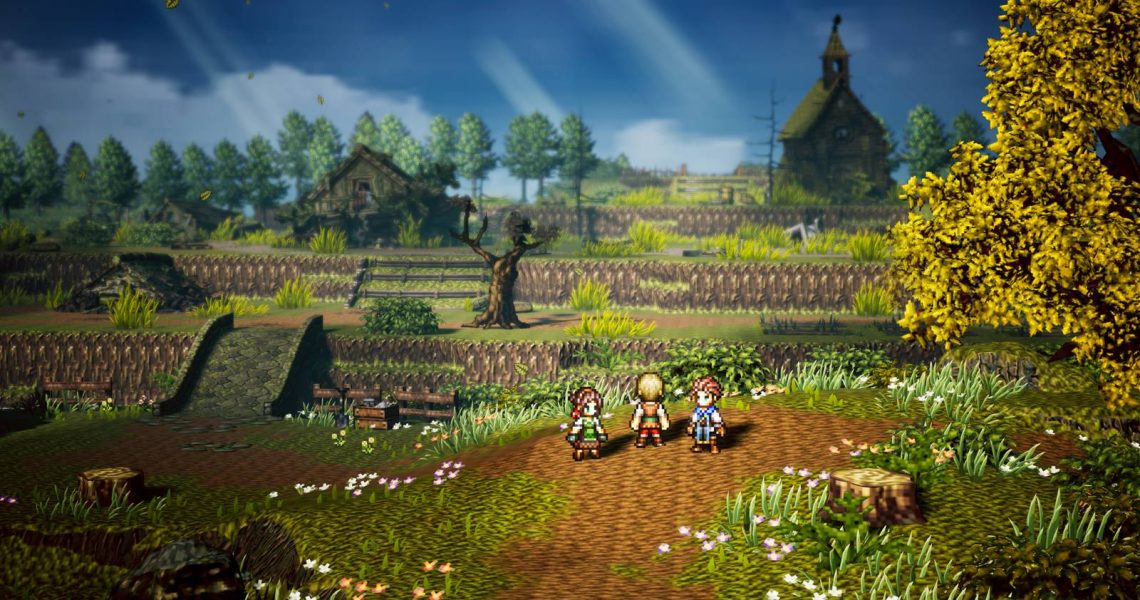
Exploration is nonetheless a beautiful experience in Octopath Traveler 0, just as it always has been in the series. Not once do the latest entry’s environments feel shallow or one-note, with frequent contrasts in the landscapes and backgrounds through the game’s impeccable use of lighting and color. The soundtrack, which fits right in with Octopath Traveler 0‘s diverse environments, is also something worth praising. There are a handful of tracks that the game will use for main story beats, but the world itself is accompanied by music that will easily get stuck in your head if you stick around in an area too long. My only wish is that exploration was a little more open.
Octopath Traveler 0 Is a Compelling Adventure That Holds Its Best Features Back

Octopath Traveler 0 is a game I’m glad I spent time with, even if it made me sigh as often as it made me lean forward. It delivers some of the series’ most memorable moments, both in how it tells its story and in how it lets you build a small corner of its world through Wishvale. At the same time, its constant cutscenes, uneven rewards, and reliance on the illusion of choice keep it from reaching the heights it seems so close to touching. For every moment I was absorbed by its atmosphere or impressed by its combat, there was another where I felt the game tug me back into a pace that wasn’t my own. Even so, there is a sincerity to this entry that stuck with me. It might not be the total reinvention some fans hoped for, but it still carries the heart of the series, and that was enough to make the journey worthwhile.

- Released
-
December 4, 2025
- ESRB
-
T For Teen // Blood, Fantasy Violence, Language, Suggestive Themes
- Franchise
-
Octopath Traveler
- Beautiful world design and soundtrack
- Wishvale is deeply rewarding
- Combat pacing feels smoother
- Dark, gripping central story
- Story pacing overwhelms gameplay
- Illusion of choice persists
- Poor rewards for tough battles
Octopath Traveler 0 launches on PC, Xbox Series X|S, PS4/PS5, and Nintendo Switch/Switch 2 on December 4, 2025. Game Rant was provided a PC game code for the purposes of this review.