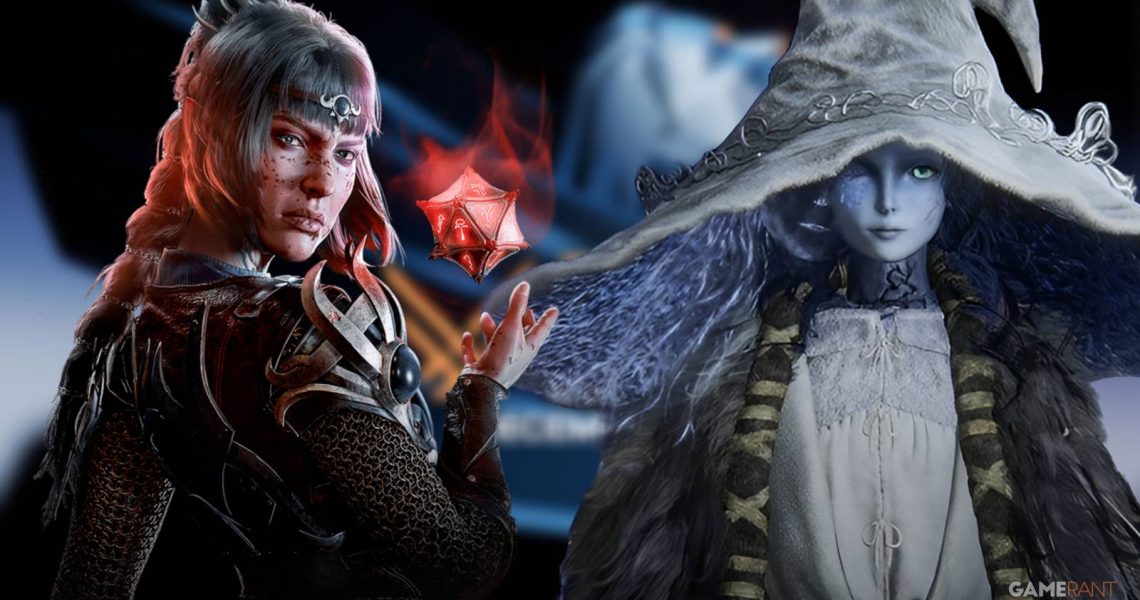
Which GOTY is Actually Better?
The Game Awards is an interesting event for a number of reasons, not the least of which being the delivery of much-deserved praise for some of the medium’s best releases. We tend to observe this celebratory atmosphere the most during years when one game sweeps the awards, emerging as the clear victor across several categories, not just the much-coveted honor of Game of the Year. In recent memory, there are few games that have fit this description better than Elden Ring and Baldur’s Gate 3, winners of the 2022 and 2023 Game of the Year awards respectively.
These games are remarkably different, but they have a few key similarities, which may help explain their popularity. Yes, they are both high-fantasy RPGs with mature elements and a focus on a single-player campaign, but more than that, they are complete, uncompromised, ambitious projects, serving as welcome reprieves from the often workmanlike, obligatory games pushed out each year by other AAA studios. In other words, Elden Ring and Baldur’s Gate 3 have integrity and vision. These games don’t have to make you like them; you’ll be hooked whether you want to be or not. And of course, their total lack of microtransactions and other ghoulish industry trends has certainly helped. Having said all that, it’s interesting to evaluate these landmark releases now that a few years have passed, taking into account their cultural impact, innovation, critical reception, and raw “fun factor” to determine which one is more worth players’ time.
Clash of the Titans: Baldur’s Gate 3 Vs. Elden Ring
Because these games are so different (and because I value my safety), I’ll be analyzing them across specific vectors and categories, ruling one title as the victor in each area rather than overall. For example, it wouldn’t be fair to say something like “Elden Ring has better combat than Baldur’s Gate 3,” since each game presents radically, fundamentally different combat mechanics. Zooming out a bit further, it’s much easier to draw comparisons.
Baldur’s Gate 3 Has Elden Ring Beat in Innovation and Creativity

If you’ve been playing RPGs for more than a few years, I probably don’t have to tell you just how groundbreaking and ambitious Baldur’s Gate 3 is. In a nutshell, BG3 is a choice-based RPG, following in the footsteps of games like Fallout: New Vegas, Pillars of Eternity, Dragon Age, and Mass Effect. But these predecessors, especially more cinematic ones like Mass Effect, are often more concerned with the illusion of choice than real, meaningful agency. For instance, you have dialog choices in Mass Effect, but most conversations will end the same way regardless of which options are picked. This approach isn’t devoid of value—it can elevate immersion, for one thing—but it’s also a constant reminder that you’re playing a video game. The illusion is poorly maintained.
When the choice-based RPGs of old actually present meaningful choices, like when Mass Effect 1 forces players to choose between saving Ashley and Kaiden, it can still feel like an on-rails decision. It’s like a fork in the road: you technically have the choice between the left path and the right path, but it was always going to come down to just these two choices. Rarely do such games involve dynamic or compounding choices, where one decision leads organically to the next, and where repeat playthroughs feel genuinely unpredictable and novel. But Baldur’s Gate 3 does involve such choices, and in doing so, it manages to be the closest approximation of tabletop role-playing the gaming medium has ever seen.
The breadth and freedom of choice offered by Baldur’s Gate 3 never feels like a gimmick or cheap trick, but simply another way for players to express themselves within the game world. Choices and consequences usually won’t boil down to a simple back-and-forth conversation with slightly different dialog depending on the player’s decisions: entire questlines can be skipped, pivotal characters, including party members, can die and be lost forever, you can either befriend or betray various NPCs, only to get your just deserts hours later, and so on. Crucially, the decision-making process is a reward in and of itself, rather than just a series of binary choices leading to the “real” narrative or gameplay rewards down the line.
Elden Ring Isn’t as Innovative as Baldur’s Gate 3, but It’s the Pinnacle of Its Genre

One of the reasons why it’s so interesting to compare Elden Ring to Baldur’s Gate 3 is that, while it’s certainly inventive and ambitious in many ways, Elden Ring is far less boundary-pushing than BG3. Ahead of launch, Elden Ring was often called the “open-world Dark Souls,” and while this title was often used derisively, it also fits the final project. Elden Ring is, in essence, a culmination of FromSoftware’s modern body of work up until that point, which is precisely what makes it such a masterwork.
Within the broader context of post-2010 action-RPGs, Elden Ring represents something of a “final form,” a mash-up of the design pillars that FromSoftware popularized back in Dark Souls and Demon’s Souls, which later propagated throughout the entire industry. Elden Ring is THE open-world action-RPG of its generation, polishing all of its FromSoftware-isms to a brilliant sheen: combat is tough but flexible and expressive, exploration is intrinsically driven and engaging, and its art design, lore, and atmosphere are all best-in-class. It may not be as groundbreaking as Baldur’s Gate 3, but it represents the peak of a very specific, influential video game formula.
Elden Ring is, in essence, a culmination of FromSoftware’s modern body of work up until that point, which is precisely what makes it such a masterwork.

Also worth noting is Elden Ring‘s cultural impact. While Baldur’s Gate 3 is certainly extremely popular, Elden Ring‘s success with mainstream audiences is nigh unprecedented: it marks one of the few times that a year’s most-discussed game, across several different demographics, was something other than Call of Duty, FIFA, or the like. It brought high art to the gaming masses, which is no small feat. While Baldur’s Gate 3 will be a better game in the eyes of gamers who like choice-based RPGs with a focus on clear storytelling and characters, Elden Ring will be superior for those seeking action, deep lore to speculate about, and a challenging-but-rewarding gameplay loop. Ultimately, both games are masterpieces, with each being better at specific things as opposed to one being the clear-cut “best” game of the two.

- Released
-
February 25, 2022
- ESRB
-
M for Mature: Blood and Gore, Language, Suggestive Themes, Violence