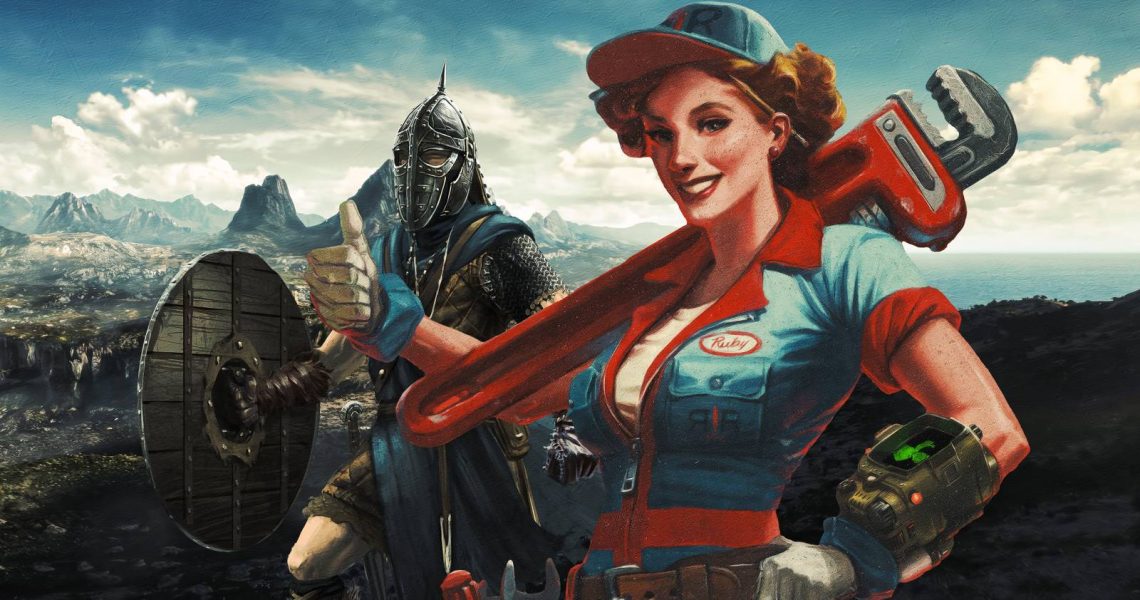
The Elder Scrolls 6’s “Classic Style” of Bethesda Game is a Problem (For Players Like Me)
Everyone knows The Elder Scrolls 6 is still years away, meaning any updates are going to be small in the grand scheme of things. As such, it’s not saying much that Bethesda director/executive producer Todd Howard’s recent comments on the sequel were the biggest reveals yet. And unfortunately, these confirmations on The Elder Scrolls 6 provide little to no relief for players like me.
To be clear, I loved growing up alongside and playing Bethesda games. I’ll swear up and down that the original Oblivion is the best Elder Scrolls game, even if I have also bought Skyrim multiple times. I was the perfect mark for Oblivion Remastered, and I have played every Fallout game since FO3 (even if I think New Vegas is the best). I also put my fair share of hours into Starfield, despite it not exactly being what I liked about past games. In dealing with that, I have had to come to terms with the fact that Bethesda games haven’t really changed.
In a recent interview with Kinda Funny Games, Howard provided a few official insights into The Elder Scrolls 6. He revealed the team is about to hit a major milestone, but that the release is “still a while yet.” He revealed that Bethesda has worked on upgrading the Creation Engine, bringing it up to Creation Engine 3, which will power The Elder Scrolls 6.

Drag weapons to fill the grid
Drag weapons to fill the grid
EasyMediumHard
But where it gets concerning is Howard’s comments on the type of game The Elder Scrolls 6 will be: “In some ways, in many ways, Fallout 76 and Starfield are a little bit of a creative detour from that kind of classic Elder Scrolls or Fallout.” Continuing, he cited Skyrim, Fallout 3, Fallout 4, and Oblivion as classics, and went on to say,
“As we come back to The Elder Scrolls 6, we’re coming back to that kind of classic style that we’ve missed and that we know really, really well.”
And that’s not really the news I wanted to hear about The Elder Scrolls 6.
Why Fallout 76 and Starfield Are “Creative Detours”
Not to argue with someone responsible for the games, but I see neither Fallout 76 nor Starfield as “creative detours.” It’s no secret that Fallout 76 was lamented at release for its emphasis on multiplayer, but the past few years have been spent building it into a fantastic Fallout game. Every season of Fallout 76 expands it, and it’s well worth playing today. It’s also no secret that Starfield, as an RPG, has not lived up to Bethesda’s reputation, but I would argue that’s a result of nostalgia because it’s a classic Bethesda game with loading screens for planetary travel.
Strip away how these games “detoured” from “classic Bethesda games” in terms of style and direction, and they are classic Bethesda games underneath it all. As much as I love Fallout 76 for its story, events, and worldbuilding, the fact remains that exploring it is not that different from other Fallout games. As much as I thought Starfield was basic as a sci-fi game and RPG, the fact remains that its most basic elements are not that different from those of other “classic Bethesda games.” Again, I love Fallout 76 and consider its “classic Bethesda elements” as its weakest parts, while I was largely disappointed by Starfield because of its “classic Bethesda elements.”
The game industry is big on words like “innovation” and “evolution,” and sometimes this is just marketing language more than anything. But that’s a problem here. It’s hard to say that Fallout 76 and Starfield are not “classic Bethesda games” when there are no real “modern Bethesda games.”
Let’s do a thought experiment. Let’s say The Elder Scrolls 6 is set in the region of Hammerfell, let’s say it starts off with the player as a prisoner, and let’s say the player is some form of chosen one. Let’s say the exploration and world design is just like Skyrim, which you may have played a dozen times and purchased half a dozen times. Let’s say it’s the most technically polished Bethesda game ever, the story is as good as you’d expect, and everything lives up to the expectations of a “classic Bethesda game.” Does that sound like something you’d play to completion in the year 2030?
For context, everyone had the chance to play a “classic Bethesda game” in 2025. Oblivion Remastered was released and performed well by key metrics like Game Pass and straight-up sales. But only half of Oblivion Remastered players reached 15 hours, and it’s a great remaster, on top of being a classic Bethesda game, for its best Elder Scrolls game. Who’s going to put 100 hours into The Elder Scrolls 6: Skyrim 2? I’ve already played that game, many times.
If Oblivion Remastered is any indication, if how RPGs and open-world games have changed and grown since 2012 is any indication, then “classic Bethesda style” may not be enough for The Elder Scrolls 6. Hopefully, this is just marketing language (people love nostalgia), and Bethesda is looking into genuinely innovating—not the marketing definition usage—its otherwise arguably antiquated approach to games.



- Released
-
2026
- ESRB
-
m
- Developer(s)
-
Bethesda Game Studios
- Publisher(s)
-
Bethesda Softworks