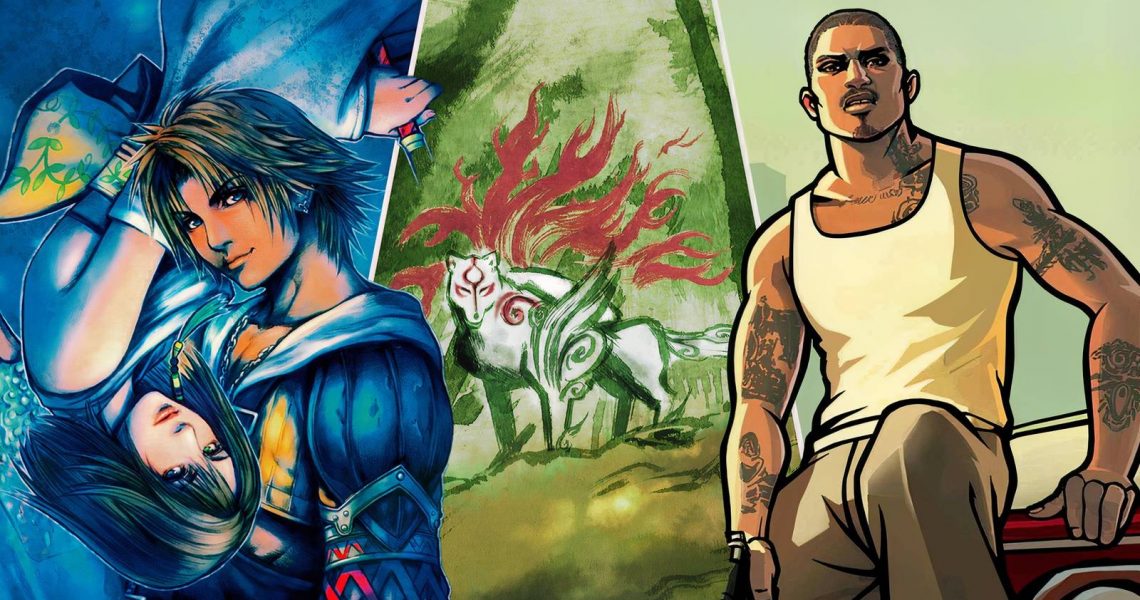
The Best PlayStation 2 Games Ever Made, Ranked
The PlayStation revolutionized the face of gaming through its exploration of 3D graphics and the simple fact that it served as competition against Nintendo. Then it was succeeded by the PlayStation 2, which is still the best-selling console of all time, an absurd feat considering gaming was not as mainstream as it is today. The console’s initial success can be credited to a few things, like its DVD functionality, but its enduring legacy is almost entirely because of its library. Along with quantity, the PS2 produced quality across nearly every genre that was feasible on consoles.
Which was the best PS2 game? Frankly, answering that question is quite a challenge, and there are arguably more than a hundred contenders. We are talking about some of the most beloved, influential, and experimental games of all time, ones that hold a special place in the hearts of millions.
Well, let’s give it a go.
In the name of variety, we are going to limit franchises to one game, and we are going to cover as many genres as possible.
15
Ratchet & Clank: Up Your Arsenal
The Pinnacle Of A Proper PS2 Success Story, And Just An All-Around Masterfully Done 3D Action-Platformer
The PS1 helped define 3D platformers, but the PS2 represented the genre’s peak, at least for Sony’s consoles. By the early 2000s, developers had a clear picture of what worked in this format, meaning they could focus on building on the fundamentals rather than having to worry about fine-tuning them.
With Ratchet & Clank, Insomniac created one of the most consistently amazing trilogies on the PS2, and all three games are among the greatest releases on the console. Up Your Arsenal gets the nod, but it is really a matter of personal preference. Along with hilarious comedy and likable characters, the gameplay was and still is a blast, blending combat and platforming to near perfection. Insomniac even threw in an online multiplayer, which was novel for the PS2.
14
Prince of Persia: The Sands of Time
The Cinematic Platformer Gets a Facelift for the 2000s
The original Prince of Persia was the genesis for cinematic platformers. Its games used more realistic physics to help its heroes get around elaborate obstacles and traps. Flashback, Out of this World, and Oddworld: Abe’s Odyssee all owe something to Jordan Mechner’s old-school action-adventure title. However, when 3D gaming became the norm, adapting the Arabian adventurer to the third dimension proved to be a challenge. Prince of Persia 3D is best left forgotten.
Ubisoft had better luck when they revived it as Prince of Persia: The Sands of Time. Like the original, it sees an unnamed prince try to save a princess from a wicked vizier. But now, he works with the princess to stop the vizier from using the titular Sands to take control of the land of Azad. The Prince can fight back, but combat isn’t the main focus. Instead, with the Dagger of Time, the player can rewind time by 10 seconds to find openings to strike back, get the right time to jump around tricky obstacles, or avoid death.
13
Gran Turismo 3: A-Spec
The PS1’s Best Racing Series Makes Its PS2 Debut
The PS1 was a pretty good system for crazier car games, like the sleek, futuristic fun of the Wipeout games, the kart racing challenge of Crash Team Racing, or the gas-powered mayhem of Twisted Metal. But players who wanted something more realistic gravitated towards the Gran Turismo games. The first game became the PS1’s best-selling game of all time, and its sequel was its gameplay peak. Then Polyphony Digital had to make a sequel for the PS2.
Gran Turismo 3: A-Spec is a bit of a two-steps-forward, one-step-back affair. The graphics were stellar for their time, and the vehicle handling got more realistic, especially if players were using the GT Force steering wheel, which applied force feedback with each turn and maneuver. However, it had fewer cars on offer than GT2, and its challenging gameplay made getting upgrades tough. Nonetheless, it’s still part of the series’ golden age, standing proud alongside its predecessor and successor.
12
Resident Evil 4
Too Big for One Console to Keep
Resident Evil 4 was meant to be a GameCube exclusive. It was part of the ‘Capcom 5’, next to Viewtiful Joe, Killer 7, P.N.03, and Dead Phoenix, which would all help beef up that console’s library. Instead, Dead Phoenix got canceled, and all but P.N.03 got ports to other consoles. Still, Nintendo had the last laugh. The PS2 ports of RE4, VJ, and K7 are generally considered to be weaker than their originals, thanks to their graphical compromises, longer load times, etc.

Every Main Resident Evil Game In Release Order
The Resident Evil franchise has been around for decades and is responsible for some of the greatest horror games ever. Here are all the main releases.
However, RE4 on PS2 did boast some extra features. It was the first version of the game to offer the ‘Separate Ways’ campaign, where players saw what Leon’s frenemy Ada was doing during her side of the game. It also offered new outfits and weapons, like the P.R.L laser gun, which could instantly kill any foe once fully charged. These features would be carried over to every subsequent port of the game, leaving the GameCube original looking prettier, but more bare-boned by comparison.
Nowadays, the PS2 version of RE4 is not the best way to experience this masterpiece, especially with the release of the PS5 remake.

Rearrange the covers into the correct US release order.
Rearrange the covers into the correct US release order.
Easy (5)Medium (7)Hard (10)
11
Madden NFL 2005
Making the Winning Play on the PS2

Madden had an absurdly great 2000s run, with the franchise delivering GOTY contenders for what seemed like most of the decade. While an argument could be made for nearly all the PS2-era releases, Madden NFL 2005 is arguably the pinnacle, along with 2008. The latter’s PS2 release had some nice features, but the game was better than its HD counterparts, like the Xbox 360 and PS3. While the former expanded on its predecessor with a refined Franchise mode, varied plays, and extra creative options.
The Franchise mode introduced Storyline Central, which turned the player’s team into a group of individuals with their own quirks and needs instead of a horde of NPCs. If players didn’t care for the extra drama, they could vary their defensive plays through Defensive Playmaker Control, helping them fine-tune their team against the tricky AI. Then they could time their stick-flicking right to barrel into a rival player to stop them dead in their tracks, all while their customized fans cheer them on.
10
Devil May Cry
An Aborted Survival Horror Sequel Became a Genre-Defining Classic
It’s a familiar story today: Hideki Kamiya’s Resident Evil 4 sequel was deemed too ‘action-heavy’ by producer and series creator Shinji Mikami, who suggested it should be its own game instead. As a result, it became Devil May Cry. The demon hunter Dante travels to Mallet Island, where Mundus, the monstrosity that was responsible for killing his mother and brother, is planning to rise again after being smote by Dante’s legendary demonic father, Sparda.
It still shows some of its RE roots, like its set camera angles, Dante’s inner monologue, elaborate death scenes, and cheesy voice acting. However, the mission-based levels, secret challenges, smooth melee combat, and its grading system made it fresh and new back in 2001. Its formula has since been refined, including by Kamiya himself with Bayonetta, but DMC1 was the first game to get the party started.
Honorable mention to Devil May Cry 3, which has arguably better combat than the original game.
9
Tekken 5
The King of Iron Fist Reclaims Its Throne
The 2000s weren’t the best time for fighting games. With the death of the arcade scene and online play not being commonplace until later in the decade, fans didn’t have much to work with. Dedicated fans could find the likes of Guilty Gear X2 #Reload and the Melty Blood franchise. But without the right arcades or the right hardware, players only had access to the genre’s biggest hitters. For an in-depth combat experience, there was VF4: Evo. For multiple characters, flashy combos, and plenty of gameplay modes, there was Tekken 5.

5 Region-Locked Playable Characters In Fighting Games
Due to various complications, these characters were rendered unplayable in overseas releases of their respective games.
The game was a shift back to formula, after Tekken 4‘s approach to space control didn’t find favor with fans. T5 retained T4‘s walled stages, but had more of the old school endless-style stages too. More classic characters came back, like Bruce and Anna, as well as new ones like Asuka, Raven, and Feng Wei. Devil Jin also became playable for the first time, bringing back his T3 move set with the Devil’s laser-blasting moves.
Honorable mention to Virtua Fighter 4: Evolution, which would have been number 16 in this article.
8
Tony Hawk’s Pro Skater 3
One Of The First Truly Great PS2 Games
Building on the inescapable success of Tony Hawk’s Pro Skater on the PS1, the franchise debuted on the PS2 with arguably its greatest game ever, although THPS4 is nearly just as brilliant. Tony Hawk’s Pro Skater 3 was one of the first truly “must-own” games on the console, becoming not only a pillar for the PS2 but also for the early 2000s on the whole. It perfected the arcade design the series had been working on, crafting a gameplay loop that is timeless, addictive, and just fun.
THPS3 is kind of weird. On paper, this should be the most niche release on the list, as we are talking about an extreme sports game. However, everyone had THPS3, and it is one of the first games that comes to mind when most people think of “PS2.” It represented a simpler era.
7
Shadow of the Colossus
The Premier Game for Giant Killing
For God of War, Sony Santa Monica Studios had wanted to turn the Titan Cronos into a level unto himself. However, time constraints led them to reduce it to a cutscene. They’d go back to the idea for God of War 3, but by then, Shadow of the Colossus had shown players what it’s like to turn giants into platform challenges. In the game, Wander rides through the open world on Agro, his horse, in search of 16 giants. In vanquishing each one, he thinks it will revive Mono, a girl sacrificed for her ‘cursed destiny.’
Each of the colossi offers a different challenge, as players have to get up close enough to them to find their weak point: a glowing sigil. Some have to be climbed, where players have to hold on tight to avoid being shaken off. Others require Agro’s help, or diving into deep water to reach them. It’s an understated, melancholy game that’s inspired a lot of successors.
6
Okami
Perhaps the PS2’s Most Underrated Game

Okami
- Released
-
September 19, 2006
Today, Okami is considered a classic title, as players help Amaterasu save the world from darkness by fighting off foes with a variety of weapons. The most intriguing of these is the Celestial Brush. Players can use it to draw different shapes that can produce different attacks, get around obstacles, open new paths, and more. Both its and Amaterasu’s stats can be improved with Praise, which is earned by doing sidequests and other little side activities.
So, why did it flop on release? Critics loved this game, as did anyone who gave it a try. It did have flaws, like uneven difficulty, though this didn’t stop its rivals. The game was released late in the PS2’s lifespan, where even its biggest successes had trouble standing out. Its unique woodblock painting-inspired graphics weren’t as wow-inducing as the next-gen games either, despite being picturesque in their own right. As such, the game’s re-releases on modern machines ended up getting a better reception.
Honorable mention to God Hand, which very nearly made the cut. Clover Studio’s output was ridiculous in 2006.